
Our readers keep the lights on and the garage heater humming. As an Amazon Associate, I earn from qualifying purchases.
Specs are compiled from manufacturer listings and verified buyer reviews and can change over time — please confirm the key details on the product page before buying.
You are already watching your fuel gauge, your mirrors, and the clock. The one number you are not watching — the pressure inside each tire — is the one that can end your trip. A slow leak you cannot feel, a temperature spike you cannot see, a blowout that costs you the whole rig. That is why the right wireless tire pressure sensor is not a gadget — it is the early warning system your tires never came with. This guide cuts through the spec noise to explain what makes a TPMS worth mounting on your dash, from alarm modes to sensor range and display readability, with real owner feedback baked into every pick.
I’m Mo Maruf — the founder and writer behind GoCarLife. This guide is built by comparing the manufacturers’ published specifications and the patterns across verified customer reviews, so you get each pick’s real strengths and trade-offs instead of marketing spin.
Whether you drive a daily sedan or tow a 35-foot fifth wheel, these are the best wireless tire pressure sensor systems for keeping your ride stable, your fuel economy honest, and your family safe from the one surprise no driver needs.
Our Picks at a Glance

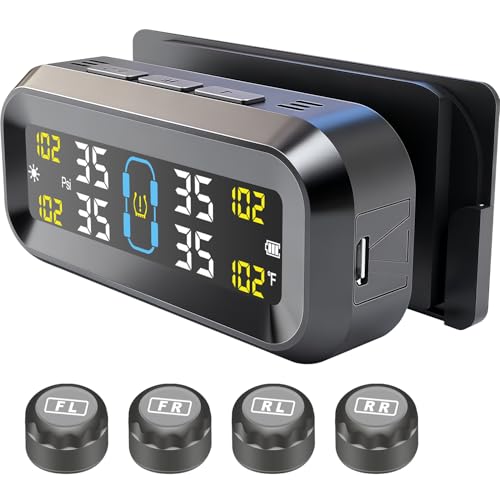

How To Choose The Best Wireless Tire Pressure Sensor
Every TPMS on the market claims to save your tires. The difference depends on how fast it alerts, how far it reaches, and whether you can read the screen in broad daylight. Here is what separates a system that earns its spot on your dash from one that collects dust in the glovebox.
Alarm Speed and Mode Variety
A system that only beeps when a tire is flat is too late. You want one that catches rapid air loss, high temperature, low sensor voltage, and lost signal before anything critical. Six alarm modes is the current standard — anything fewer means you are missing at least one early warning.
Sensor Range and Signal Strength
For a passenger car, a 32-foot range is plenty. For an RV towing a trailer, you need a system that reaches at least 50 feet, and ideally one that includes or supports a signal booster. Without enough range, the dash monitor loses contact with the rear trailer tires and you are back to blind driving.
Display Visibility and Charging
The brightest color screen is useless if it washes out under direct sun. Look for an adaptive backlight and an anti-reflective coating. Solar charging is convenient for daytime drivers, but a USB backup (USB-C is fastest) ensures the monitor does not go dark during a stretch of cloudy days or winter trips.
Quick Comparison
| Model | Best For | PSI Range | Alarm Modes | Charging | Amazon |
|---|---|---|---|---|---|
| Masoll RV TPMS (4 sensors)★ Best Overall | Best Overall | 0–99 PSI | 6 modes | Solar + USB | Amazon |
| Tire Pressure Monitoring System (4 sensors)Budget Champion | Budget-Friendly | 0–99 PSI | 6 modes | Solar + USB | Amazon |
| Masoll M13 TPMS (4 sensors)Auto-Set Genius | Auto Calibration | 0–87 PSI | 6 modes | Solar | Amazon |
| Flydew TPMS (4 sensors) | USB-C Charging | 0–99 PSI | 6 modes | Solar + USB-C | Amazon |
| Marcala V2.0 TPMS (6 sensors) | 32ft Trailer Range | 0–144 PSI | 6 modes | Solar + USB | Amazon |
| Tymate TM3 TPMS (4 sensors) | Up to 10 Tires | 0–144 PSI | 6 modes | Solar + USB-C | Amazon |
| GUTA GT20 TPMS (10 sensors) | 100ft Signal Range | 0–188 PSI | 6 modes | USB-C | Amazon |
| TireMinder i10 TPMS (6 transmitters) | Professional RV Use | 0–199 PSI | 6 modes | USB | Amazon |
| TST 507 Series TPMS (4 cap sensors) | Premium Expandable | 0–199 PSI | 6 modes | Micro-USB | Amazon |
In‑Depth Reviews
1. Masoll RV Tire Pressure Monitoring System, TPMS with 4 Sensors
Our pick — over 4.5★ from 300+ verified ratings; the strongest balance of quality and price.
The dashboard guardian that caught a nail in the Yukon and kept a family rolling.
The Masoll is the rare gadget that delivers exactly what its listing promises: hands-off confidence. The four external sensors are pre-programmed at the factory, so you thread them onto the valve stems (following the position markings), turn the monitor on, and within minutes you see real-time pressure and temperature for all four tires. No pairing dance, no app to download. The solar panel on the monitor keeps the battery topped up during daytime drives, and a USB cable is included for backup when the sun disappears on a long overcast haul.
The thing that earns this system its following is what happens when something goes wrong. Six alarm modes — high pressure, low pressure, high temperature, fast leakage, low sensor voltage, and lost signal — trigger an audible beep and a visual alert on the color screen. It weighs 8.8 ounces, but that extra heft comes from a larger solar lithium battery panel designed to hold charge across longer trips. Buyers report that the auto-set alarm values use a ±25% and -15% window around your reference pressure, so there is zero guesswork. The screen can be hard to read in direct summer heat above 100°F, as some owners note, but it recovers once the cabin air conditioning circulates.
On a 21-foot trailer, the system detected a pressure loss a hundred miles into a trip, allowing the driver to swap the tire before the rim ground into the pavement. Another owner driving through the Canadian Yukon got an alarm for a nail puncture — a real-world scenario that saved the sidewall. The sensors run on replaceable CR1632 batteries with a rated two-year life, and the monitor itself auto-sleeps on vibration detection, so you are not draining power during parking. For a four-wheel system that covers sedans, SUVs, trucks, and RVs up to 38 feet (a signal booster is recommended beyond that), this is the pick that balances proven reliability with a price that does not sting.
What Owners Trust Most
- Pre-paired sensors install in under five minutes with zero wiring
- Solar charging plus USB backup means the monitor stays alive in any weather
- Auto-calibration sets alarm thresholds without manual input
The Trade-Off to Know
- Display visibility fades under direct intense sunlight above 100°F
- At 8.8 ounces it is noticeably heavier than lighter solar monitors
Grab this if: you want a no-wire, no-app TPMS that installs in minutes and has a proven track record of catching leaks before they become blowouts.
Consider another if: you drive in extreme desert heat regularly and need a screen that stays readable at high noon without relying on cabin AC.
2. Tire Pressure Monitoring System with Solar & USB Charger
A genuine sub-4-ounce system that delivers accurate psi readings without the premium price.
The system cuts weight dramatically — 4.16 ounces, compared to the Masoll’s 8.8 ounces — while keeping all six alarm modes and the same 0–99 PSI monitoring range. The plastic body feels less substantial in the hand, but the trade-off is a monitor that sticks to the windshield without sagging. Owners highlight that it reads pressure accurate to 1 psi, matching their handheld gauge. The manufacturer lists a measurement accuracy of ±3.03%, which translates to real-world confidence that when the system says 35 PSI, the tire is actually at 35 PSI. One owner used it to replace his Mazda’s factory TPMS, which only warned of low pressure without giving a per-tire readout — a solid upgrade for anyone driving an older vehicle.
Charging works via solar panel or USB cable, and owners mention it charges even on cloudy days. The adaptive backlight on the LCD screen adjusts brightness automatically, and the system wakes from sleep mode the moment the car starts. The recurring note from owners is that the receiver must sit high on the windshield for the solar panel to catch enough sun — if you park under cover for long stretches, you will rely on the USB cable more often.
The IP68 waterproof rating on the external sensors (dustproof and protected against continuous immersion) is unusual at this price, and the anti-theft lock nuts add a layer of security. For a commuter car, a daily SUV, or a light trailer where every ounce matters, this system offers the essential safety net without the mental overhead of a complicated setup.
The Savings You Actually Get
- Weighs just 4.16 ounces — easy to mount on windshield without droop
- Low tire warning accurate to 1 psi, matching handheld pressure gauges
The Real Limitation
- Monitor must sit high on windshield for consistent solar charging
- Plastic build feels less durable than mid-range metal-compound units
Choose this for: a lightweight, accurate system for your daily car or light SUV where budget is front of mind.
Look past it if: you need a rugged metal build for heavy commercial use or you cannot position the monitor for reliable solar exposure.
3. Masoll M13 Tire Pressure Monitoring System
The set-and-forget system that recalibrates itself every time you add air.
The M13 is the smarter sibling in the Masoll lineup. Where other systems require you to manually set high/low thresholds every season, this one auto-calibrates. Fill the tires to your preferred pressure, install the sensors, and the system locks that number as the reference. If you inflate or deflate later, the sensor automatically adjusts the alarm window accordingly. Owners appreciate that the readings match a digital gauge within 1 PSI, so you trust what you see. The high-definition color LCD uses an anti-reflective coating and auto-backlight adjustment, though some owners note the screen still washes out in direct sun — it is a common TPMS compromise.
The solar panel on this unit is efficient enough that customers note never needing to USB-charge after the initial top-up, even during four months of use. One owner drove 3,500 miles with a trailer and the alarm caught a slow leak before the tire went completely flat. The pressure range stops at 87 PSI, so it is not for high-pressure truck tires (many heavy-duty setups run 100+ PSI), but it covers most passenger cars, SUVs, and standard RV trailers. The sensors have a 1.5 PSI accuracy rating, which is tighter than some budget competitors. Masoll backs the monitor with a one-year warranty and the sensors with a six-month warranty.
At 8 ounces, the M13 is slightly lighter than the standard Masoll system and fits vehicles with four tires up to 38 feet. For a golf cart, a travel trailer, or a family SUV where you want to top up pressure and forget about it, this is the smooth operator.
The standout trick: the auto-calibration means you never set alarm thresholds — just fill tires to spec, install sensors, and go.
One honest caveat: highway driving can trigger false alarm beeps as tire heat builds, and the 87 PSI limit excludes heavy-truck applications.
Best suited for: RV owners who adjust tire pressure between summer and winter loads and want a system that recalibrates itself.
Pass on it if: your tires run above 87 PSI or you drive in extreme heat that triggers frequent false alarms.
4. Flydew TPMS with 4 Sensors
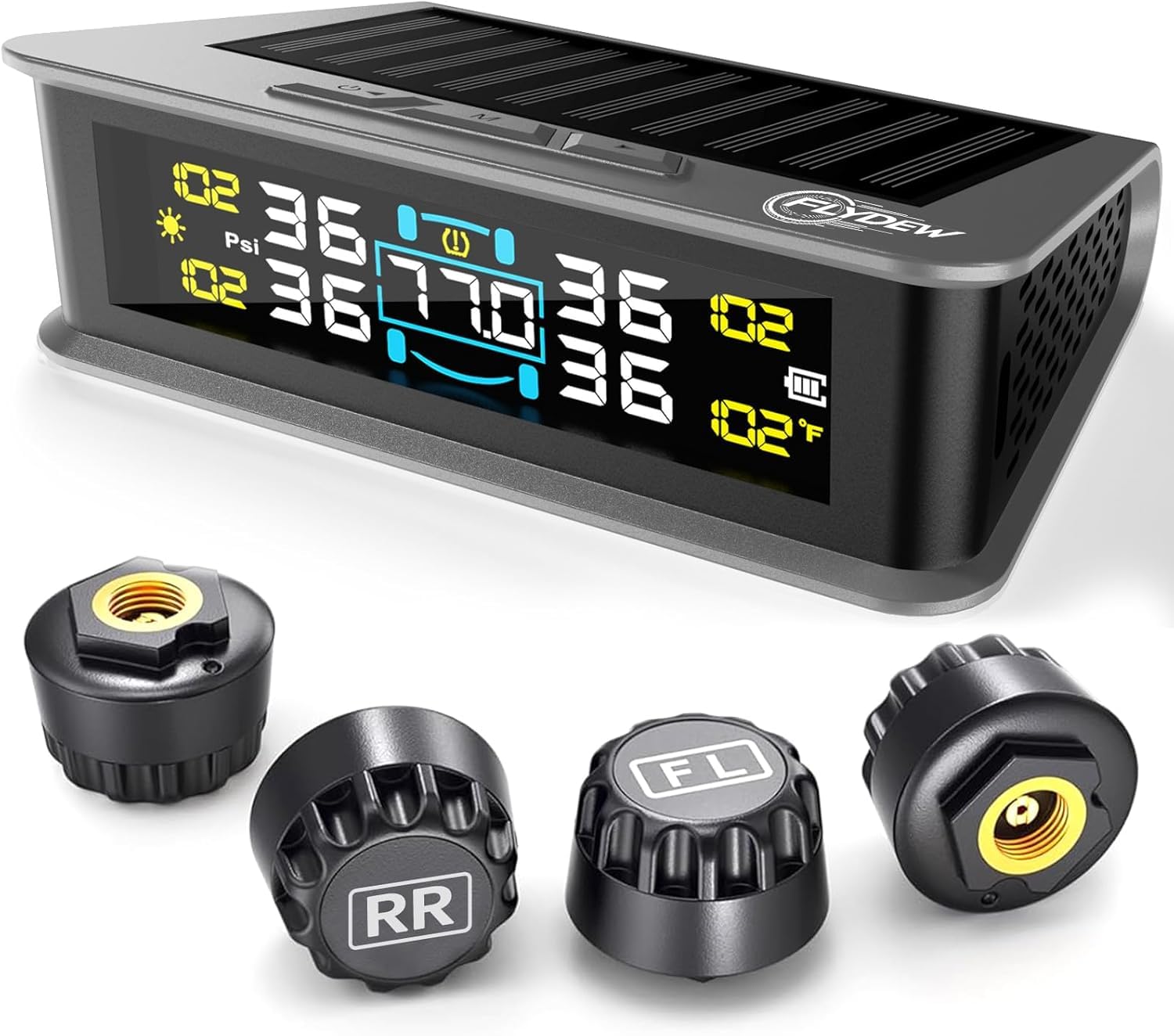
The first in this roundup to swap micro-USB for USB-C, making charging faster and cables universal.
Flydew takes a smart approach: the monitor charges via solar or USB-C, so you are not hunting for an old micro-USB cable when the panel runs low. The adjustable PSI range covers 0–99 PSI, and you can set custom high and low alarm thresholds yourself rather than relying on an auto-set baseline. That is useful if you run different pressures front to rear or tow variable loads. The four external sensors are pre-labeled and pre-paired — screw each onto its matching valve, tighten the anti-theft nut, and pressure and temperature readings populate the color LCD within a few seconds.
The build quality is plastic, and the company stands out for customer service. When a buyer broke a sensor using a long extender on a dually setup, Flydew sent an entirely new system. Another owner had a sensor that did not sync correctly, and the company replaced both the sensor and the monitor — no hassle. That kind of responsiveness matters when you are miles from civilization.
The honest assessment from the data is that accuracy is mixed. One owner reported that the system showed 70 PSI during an actual blowout, which is a serious discrepancy. Others say the values seldom change on a cargo trailer and that a temperature reading once stuck at 71°F until a reset. The thread size is 13/16″-18 UNF, which fits standard car, SUV, and small-trailer valve stems. For the buyer who prioritizes fast charging and responsive support over battlefield-proven precision, this is a reasonable mid-range bet.
The big plus: USB-C charging is genuinely more convenient than micro-USB, and the company replaces defective units without pushback.
The honest trade-off: accuracy reports are inconsistent — some reviewers point out perfect reads, others experienced mismatches that erode confidence.
Pick this if: you want the convenience of USB-C and value responsive customer support over absolute precision.
skip it if: you need proven sub-1-PSI accuracy or rely on the system for critical commercial loads.
5. Marcala V2.0 Trailer Tire Pressure Monitoring System (6 Sensors)
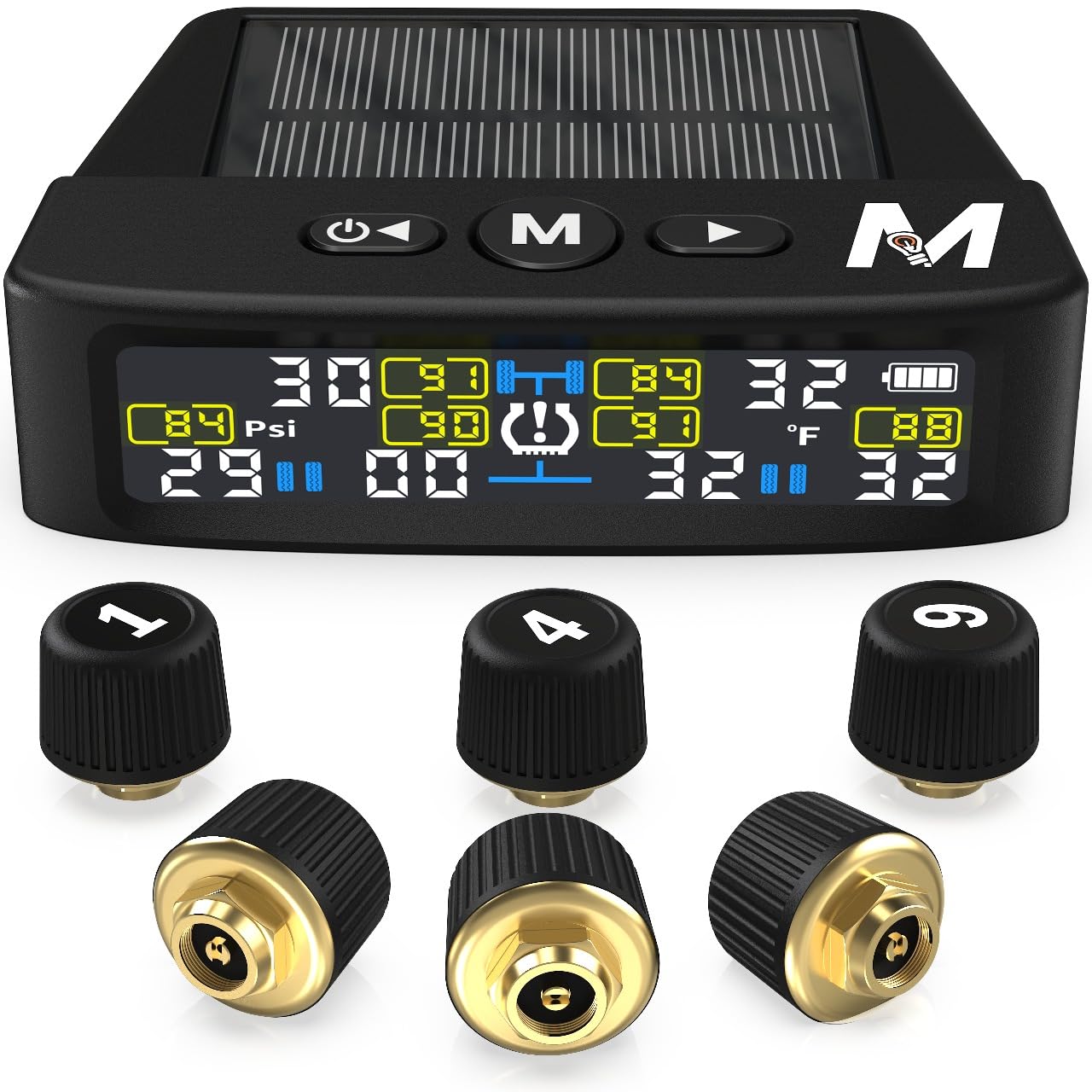
Six sensors and a 32-foot hub make this the go-to for tandem-axle trailers that need every wheel watched.
The Marcala V2.0 is built for the towing crowd that runs more than four tires. The kit includes six external sensors, a monitor, and a hub that extends the range to 32 feet — enough for a large RV or a camper towing a second vehicle. The pressure ceiling is 144 PSI, which covers everything from passenger tires to heavy-load trailer tires. The IP67 waterproof rating means rain and mud are not a concern, and the color LCD auto-dims to preserve battery life. The monitor charges via solar or USB, and the system updates tire data every second while driving. When parked, the sensors enter a power-saving mode that updates less frequently to extend battery life.
Owners praise the display visibility day or night, and the six alarm modes cover rapid air leak, high/low pressure, high temperature, low sensor voltage, and signal loss. The mounting bracket holds the monitor securely on the dash. The honest critique from the community is that the external sensors are bulky — they stick out from the valve stem and can unbalance the wheel if you do not balance them. One owner noted that the locking nut is not brass, raising durability concerns after repeated use. Marcala backs the unit with a lifetime replacement policy, which is unusual at this price tier. Whether you are towing a horse trailer behind a Yukon or hauling a camper across state lines, the V2.0 keeps all six tires visible on one screen.
The Range Advantage
- Six sensors cover tandem-axle trailers without needing a second monitor
- 144 PSI range fits high-pressure RV tires, not just passenger car tires
- Lifetime replacement policy from an American-owned company
The Installation Reality
- Bulky sensors can unbalance wheels and risk valve stem damage
- Locking nut is not brass — may degrade faster in salt-belt winters
Reach for this if: you tow a tandem-axle trailer or camper and want a single monitor watching all six tires in real time.
Look elsewhere if: every ounce of rotating mass matters (race trailer) or you need a compact sensor profile.
6. Tymate TM3 RV Tire Pressure Monitoring System (4 Sensors)
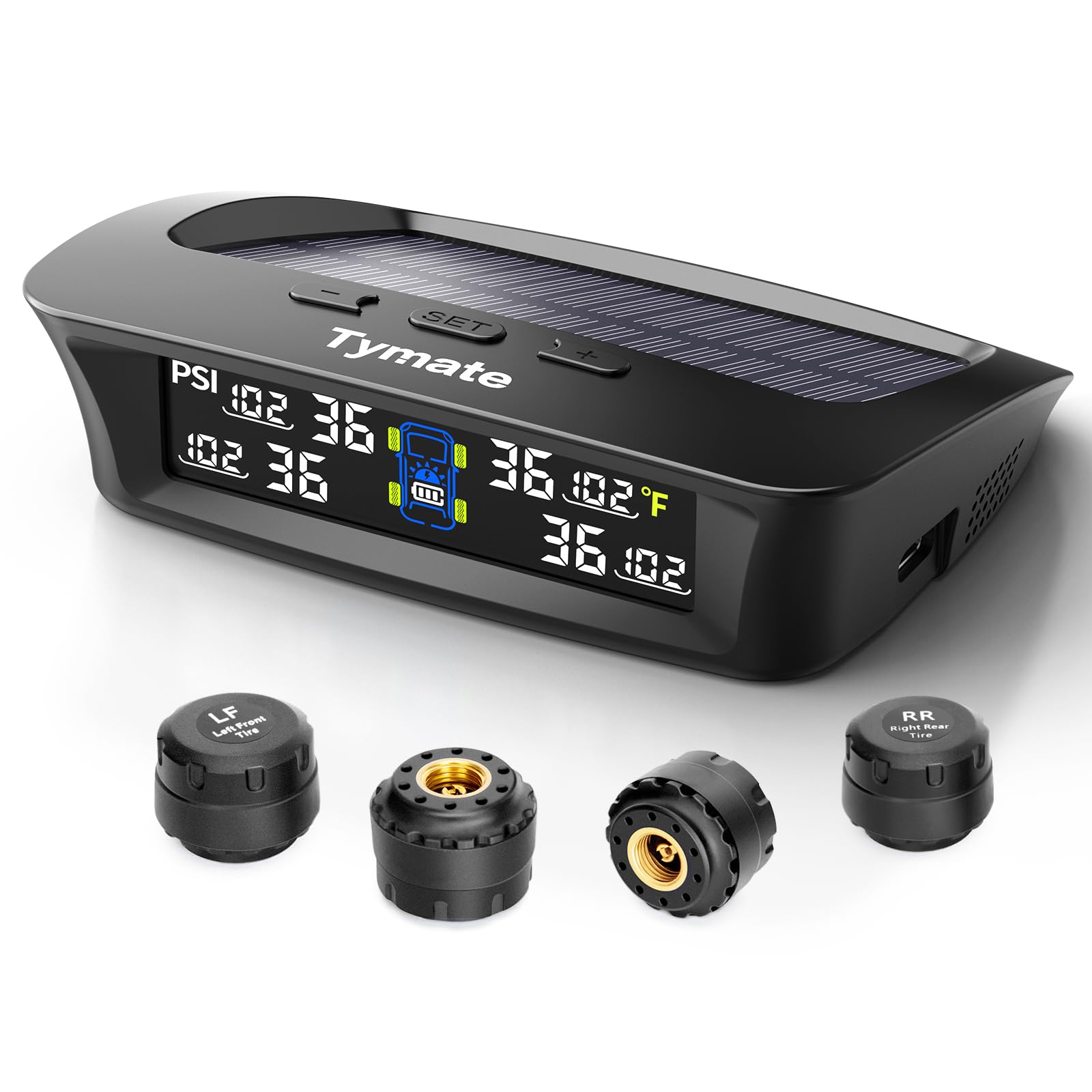
A modular system that scales from four to ten tires, perfect for a truck towing a long travel trailer.
The TM3 is Tymate’s answer to the driver who owns more than one towable vehicle or runs a truck-plus-trailer combination. The base kit comes with four sensors, but the monitor can handle up to ten tires total — you swap between the front vehicle and trailer display as needed. The pressure ceiling is 144 PSI, and the system operates on a 433.92 MHz frequency for solid penetration through long trailers. Tymate recommends installing the sensors on metal valve stems for stability and safety, and the included anti-theft nuts discourage casual removal.
The color LCD has an adaptive backlight that adjusts to ambient light, and the USB-C charging means faster top-ups compared to older micro-USB monitors. The sensors run on a CR1632 battery that Tymate rates for up to two years, with a low battery alarm so you are never caught off guard. Shoppers say that the system works well with 35-foot fifth wheels and that the solar panel keeps the monitor charged even during long stretches under overcast skies. The alarm accuracy is approximately 3 PSI margin of error, which is looser than the 1.5 PSI some competitors claim but still sufficient for catching a dropping tire before it becomes dangerous. One owner had the system immediately alert him to a PSI drop caused by a faulty valve stem, allowing him to limp to a repair shop instead of sitting on the shoulder.
For the RV owner who wants a system that grows with their setup — start with four sensors for the trailer, add six more for the tow vehicle — the TM3 offers genuine flexibility without replacing the entire monitor.
The scalability win: one monitor covers up to ten tires, so you do not buy a second system when you add a new tow vehicle.
The precision note: the ±3 PSI margin is wider than the 1.5 PSI found on some picks — adequate for leak detection, not for fine pressure tuning.
Best for: RV owners with a tow vehicle plus a trailer who want a single dashboard display for all tires.
Not ideal if: you need sub-2 PSI precision for performance tires or run rubber valve stems (metal stems recommended).
7. GUTA GT20 Trailer TPMS with 10 Sensors

A 100-foot signal with coverage for up to 24 tires — built for the semi-truck fleet or giant motorhome.
The GT20 is a different class of TPMS. It ships with ten sensors, but the monitor can track up to 24 tires total, which covers triple-axle trailers, dually trucks, and commercial tractor-trailer combinations. The pressure range extends to 188 PSI, and the temperature sensor reads from -40°F to 221°F, so it handles the brutal cold of a northern winter and the furnace heat of a summer highway. The included signal booster (all configurations except the 4-sensor kit) pushes reliable connectivity to 100 feet, making it one of the longest-range consumer TPMS units on the market.
The large color LCD screen has adjustable backlight settings and an orientation that can be flipped for truckers who prefer the monitor mounted high or low. The built-in rechargeable lithium battery lasts up to 15 hours under heavy use, and a power-saving mode kicks in after 15 minutes of inactivity. The sensors are pre-programmed at the factory, so no pairing is needed. The six alarm modes mirror the standard set, and the system auto-sets the pressure baseline after installation.
Buyers who upgraded from cheaper systems consistently note that the GT20 holds a strong signal where others dropped out. The interface cycles through each tire’s pressure and temperature automatically, and the display is bright enough for daytime driving — though a few owners wish it were brighter still. The unit ships with a comprehensive user manual and step-by-step video guides. For a commercial fleet operator or an RV owner with a multi-axle setup, the GT20 provides the coverage range that budget systems simply cannot match.
The Range That Changes Everything
- 100-foot signal range covers long trailers and semi-trucks without dropouts
- 24-tire capacity handles triple-axle and dually combinations in one monitor
- 188 PSI and 221°F range covers heavy-duty commercial tire demands
The Reality at This Price
- Monitor battery (15hr) is shorter than solar-powered units — must recharge via USB-C
- Some owners find the display dimmer than expected in direct sun
Best suited for: commercial fleets, semi-trucks, and oversized RVs where tire distance from the cab exceeds 40 feet.
Pass on it if: you only need four tires monitored and do not want to manage a recharge cycle.
8. TireMinder i10 RV TPMS with 6 Transmitters

The i10 is the system RV owners trust after trying everything cheaper and being let down.
TireMinder has been in the TPMS game longer than most, and the i10 reflects that maturity. The large 3.15-inch color LCD is easy to read from the driver’s seat, and the system checks every tire for six different issues (slow leak, rapid leak, blowout, low pressure, high pressure, and high temperature) every six seconds — that is a faster polling interval than most competitors. The kit includes six transmitters, a monitor, and a rhino signal booster, which ensures the signal reaches the back of a 40-foot motorhome without dropouts. The pressure range spans 0–199 PSI with an accuracy of ±1 PSI, and the transmitters use replaceable CR2032 batteries.
What sets the i10 apart is its proven track record in the field. Owners have logged 3,500 miles without a single glitch. The system detected a slow leak on a motorhome, letting the driver pull over and address it before the tire went flat. One owner had a sensor fail after five months, and TireMinder shipped a replacement within an hour without making the buyer jump through troubleshooting hoops. The 3-year warranty and lifetime customer support are the strongest protections in this lineup. The only consistent criticism is that the monitor digits can be hard to read in bright sunlight, a trade-off that comes with the large color display.
For the serious RV owner who plans to keep their rig for years, the i10 is an investment in reliability. It does not cut corners on sensor range, build quality, or support — and that is the right calculation when a tire failure at highway speed can total a coach.
The reliability edge: every-six-second polling detects leaks faster than systems that refresh every 10–15 seconds.
The bright-light compromise: digits wash out in direct sun, though the screen is excellent in every other lighting condition.
Pick this if: you own a motorhome or large fifth wheel and want the best-supported, most proven system on the market.
pass on it if: you need a small, lightweight monitor for a daily commuter — this is built for RV scale.
9. TST 507 Series TPMS with 4 Cap Sensors
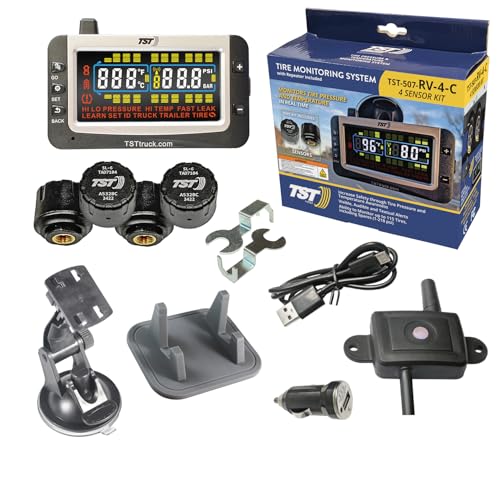
The 507 is the quiet standard among serious RVers — known for rock-solid reliability and USA-based customer service.
TST’s 507 Series is the system you see mounted in the cabs of Airstreams and Prevost coaches. The compact 3.5-inch color display uses a rechargeable battery and ships with a suction cup mount plus a rubber dash mount, giving you placement flexibility. The kit includes four cap-style sensors (screw onto the valve stem, no tools required), a signal repeater, and a magnetic mount base. The pressure range covers 0–199 PSI, and the system alerts for low pressure, high pressure, fast leaks, and high temperature with both audible and visual alarms. The display auto-locks on the problem tire so you see the issue immediately rather than cycling through all tires.
What earns the 507 its dedicated following is the simplicity of installation — buyers report setup in minutes, often following a YouTube guide that is easier than the printed manual. One customer ran a 45-foot camper without any signal loss, thanks to the included repeater. The system can monitor your towing truck plus up to four towable vehicles, making it genuinely expandable. The sensors use user-replaceable CR2032 batteries with a low-battery alert. The criticism most frequently heard is that the display only shows one tire at a time in a cycling view, unlike cheaper units that display all four simultaneously. That is a deliberate design trade-off for a simpler interface, but it means you cannot glance at all tires at once.
The TST 507 is backed by a three-year warranty and USA-based live customer support — not an email address, but a person you can call. For the buyer who plans to own their RV for a decade and wants a system that will still be supported at year eight, the 507 is the benchmark.
The Trust Factor
- Rock-solid signal range with repeater — no dropout on 45-foot campers
- Expandable to cover tow vehicle plus up to four trailers
- Three-year warranty and USA-based live customer support
The Design Quirk
- Display cycles one tire at a time rather than showing all four simultaneously
- Adding an on-off switch to the repeater is recommended to prevent battery drain
Choose this if: you want the gold standard of RV TPMS reliability with real people answering the phone when you need help.
Look elsewhere if: you prefer a visual overview of all four tires at a single glance without cycling.
Understanding the Specs
PSI Range and Alarm Thresholds
PSI (pounds per square inch) measures how much air is inside your tire. A system with a 0–99 PSI range covers passenger cars and most light trucks. Heavy-duty RVs, semi-trucks, and large trailers often need a higher ceiling — 144 PSI or 188 PSI — because their tires run at much higher pressures (typically 80–120 PSI). The alarm thresholds are the pressure window that triggers a warning. Most systems auto-set these at +25% and -15% of the reference pressure you inflate to. That means if you fill to 65 PSI, you get an alert at roughly 81 PSI (overinflation) and 55 PSI (underinflation).
Sensor Battery Life and Replaceability
External TPMS sensors are battery-powered, and the battery type determines how often you need to crack them open. The most common cell is the CR1632, which makers rate for roughly two years. The CR2032 is slightly larger and typically lasts a bit longer. The key spec is whether the battery is replaceable — some cheap sensors are sealed and must be replaced entirely when the battery dies. Look for systems that let you swap the battery yourself, and check whether a low-voltage alarm exists so you are warned before the sensor goes silent.
FAQ
Will an external TPMS sensor cause air to leak from my valve stem?
Does a TPMS monitor work with a trailer longer than 38 feet?
Can I install external sensors on rubber valve stems without upgrading to metal ones?
How do I know when the sensor battery is about to die?
What does an IP67 or IP68 waterproof rating mean for a tire sensor?
Does a TPMS drain my car battery when the engine is off?
Can I use one TPMS monitor for both my truck and my trailer?
Why does my TPMS display show a yellow flashing tire icon even when pressure is normal?
What is the difference between a cap sensor and a flow-through sensor?
Final Thoughts: The Verdict
For the vast majority of drivers — from daily commuters to weekend RV travelers — the wireless tire pressure sensor worth mounting on your dash is the Masoll 4-Sensor TPMS. It combines pre-paired sensors, solar-plus-USB charging, six alarm modes, and a proven track record of catching punctures before they strand you — all without asking you to wire anything or download an app. If you are towing a long trailer and need extra range, the Marcala V2.0 covers six tires with a 32-foot hub. And for the professional-grade buyer who wants the longest support and the most expandable system, the TST 507 is the benchmark that thousands of RV owners already trust.
How We Picked
We do not accept paid placement. Every pick is matched to a real buyer and a real use-case; we do not hands-on test units.
Sources & Methodology
Specifications: manufacturer listings and product documentation. Review insights: verified customer reviews, as of July 2026. Pricing: not shown on this page (it changes often); check the current price via the retailer link.
As an Amazon Associate, GoCarLife earns from qualifying purchases. This does not affect which products we feature.