
Our readers keep the lights on and the garage heater humming. As an Amazon Associate, I earn from qualifying purchases.
Specs are compiled from manufacturer listings and verified buyer reviews and can change over time — please confirm the key details on the product page before buying.
Picking the right wire for your battery setup depends on one thing — getting the gauge right. Too thin, and you risk voltage drop that leaves your inverter gasping or your starter motor cranking slow. Too thick, and you are wrestling stiff cable into tight engine bays and paying for copper you do not need. This guide walks you through the top-rated battery cables on the market, from pre-terminated 4 AWG jumper sets to raw 2 AWG welding cable, so you can match the right conductor to your car, boat, RV, or solar project without the guesswork.
I’m Mo Maruf — the founder and writer behind GoCarLife. This guide is built by comparing the manufacturers’ published specifications and the patterns across verified customer reviews, so you get each pick’s real strengths and trade-offs instead of marketing spin.
if you need a short fused lead for a trolling motor or bulk 10 AWG marine-grade duplex for a full rewiring job, the right wires for battery installations deliver reliable power, heat resistance, and a corrosion-proof connection that lasts years.
Our Picks at a Glance


How To Choose The Best Wires for Battery
The cable you choose for a battery connection is the lifeline of your electrical system. Pick one that is too small for the current draw, and you get resistance that generates heat and robs power. Pick a material that cannot handle moisture, and you are replacing corroded terminals within a season. Here is the shortlist of what separates a smart buy from a regret.
Gauge Size: The Thicker the Number, the Thinner the Wire
AWG stands for American Wire Gauge. Counterintuitively, a lower number means a thicker wire. A 4 AWG cable carries more current over longer distances than a 10 AWG cable without overheating. Match the gauge to your device’s amp draw and the cable run length — your inverter manual will suggest a minimum gauge, and it pays to follow it closely.
Conductor Material: Pure Copper vs Tinned Copper
Oxygen-Free Copper (OFC) offers the best conductivity for the buck. Tinned copper swaps a tiny bit of conductivity for significantly better corrosion resistance, making it the go-to for marine and outdoor applications. Avoid copper-clad aluminum (CCA) if you want the cable to last — the higher resistance and brittleness are not worth the lower up-front cost.
Insulation Jacket: PVC, Silicone, or EPDM
Standard PVC is fine for dry interior use but gets stiff in cold weather. Silicone rubber stays flexible from -60°C up to 200°C, which matters for engine-bay wiring or 3D printers. EPDM rubber resists solvents and abrasion better than silicone and is the premium pick for welding cable that doubles as battery cable in tough environments.
Quick Comparison
| Model | Best For | Gauge (AWG) | Length | Material | Amazon |
|---|---|---|---|---|---|
| A ABIGAIL 4 AWG★ Best Overall | All-around pre-terminated connection | 4 AWG | 12 in | Pure copper | Amazon |
| MMOBIEL 10 AWG SiliconeMost Versatile Spool | High-temp flexible wiring projects | 10 AWG | 8.2 ft per color | Tinned copper | Amazon |
| YCIND 12 AWG Boost CableBest Fused Lead | Fused accessory leads | 12 AWG | 10 ft | Copper | Amazon |
| TOPDC 4 AWG Cable Pair | Longer 24-inch battery runs | 4 AWG | 24 in | Pure copper | Amazon |
| Shirbly 1/0 AWG Cable | High-amp inverter or starter | 1/0 AWG | 1 ft per pair | OFC pure copper | Amazon |
| ECO-WORTHY 2 AWG Cable | Parallel battery banks | 2 AWG | 12 in per pair | Tinned copper | Amazon |
| NOVINO 10/2 Marine Wire | Full boat or trailer rewiring | 10 AWG | 30 ft | Tinned copper | Amazon |
| Shirbly 6 AWG Welding Cable | High-current custom runs | 6 AWG | 10 ft per color | OFC pure copper | Amazon |
| Shirbly 2 AWG Welding Cable | Maximum ampacity for inverters | 2 AWG | 10 ft per color | OFC pure copper | Amazon |
In‑Depth Reviews
1. A ABIGAIL 4 AWG Battery Cable
Our pick — over 4.5★ from 400+ verified ratings; the strongest balance of quality and price.
The crowd-favorite 4 AWG set that nails fit, feel, and durability in one affordable pair.
This cable pair from A ABIGAIL hits the balance for most car, RV, and solar jobs. Each 12-inch wire comes with a 3/8-inch ring terminal already crimped on both ends, so you can bolt it straight onto a battery post or inverter lug without cutting or stripping. The conductor is pure copper — not copper-clad aluminum — and buyers report that “the copper is thick, the connectors are solid, and everything feels very durable.” That thickness translates directly to steady power delivery without worrying about voltage sag on a starter motor or a solar charge controller.
The PVC insulation is flexible enough to route around an engine bay, and the cable ends are sealed with heat shrink tubing for extra moisture protection. At just 6.4 ounces per pair, it is light enough to zip-tie into place without adding unnecessary weight. Compared to the TOPDC 4 AWG pair below, this one is 12 inches long versus the TOPDC’s 24 inches, and weighs 6.4 ounces versus the TOPDC’s 12.3 ounces, making it the tidier option for short jumper connections where every inch counts.
Crimp quality that wins trust
- Pure copper conductor — no power loss from cheap alloys
- Pre-attached 3/8-inch ring terminals save installation time
- Heat-shrink sealed ends resist moisture and corrosion
- Lightweight 6.4 oz pair fits tight battery trays
One length limitation
- 12-inch reach may be too short for some remote battery banks — measure first
Reach for these if: you need a drop-in replacement or extension for a car, boat, or RV battery and want verified pure copper at a fair price.
Look elsewhere if: your terminal posts are farther than 12 inches apart — the TOPDC 24-inch pair is a better fit.
2. MMOBIEL 10 AWG Silicone Wire
The tinned-copper spool that bends like rope and shrugs off extreme heat.
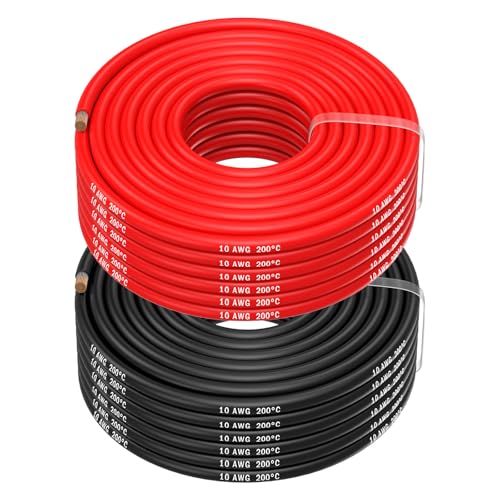
If you are wiring a 3D printer, a drone power distribution board, or a campervan’s accessory panel, this 10 AWG silicone wire is the flexible workhorse you want. It comes as two separate 8.2-foot spools — one red, one black — each made of 1,050 strands of tinned copper. That ultra-fine stranding makes it dramatically more flexible than standard PVC wire of the same gauge, so you can route it around tight corners inside an enclosure without fighting the cable.
The silicone insulation is rated from -60°C up to 200°C and handles 600 volts, so it is not fazed by engine-bay heat or soldering iron contact. Owners use it for everything from RC buggy battery leads to full camper electrical systems, with one calling it “so flexible like a snake.” Just note that you will need to source your own ring terminals or connectors — this is raw wire, not a pre-terminated cable set.
Heat and flexibility done right
- 1050-strand tinned copper core bends easily
- Silicone jacket withstands 200°C without melting
- 600V rating covers most automotive and solar DC circuits
- Two separate color-coded spools keep polarity clear
Not a plug-and-play cable
- No terminals pre-attached — you supply your own crimp or solder connections
Grab this spool if: you are running signal or moderate-power lines in a camper, robot, or printer and value flexibility and heat tolerance above all.
skip it if: you need a ready-to-bolt battery cable — pick a pre-terminated set instead.
3. YCIND 12 AWG Boost Cable with 30A Fuse
The fused extension that connects a trolling motor or accessory in one weather-resistant bundle.
This 10-foot cord from YCIND is a complete harness: two color-coded 12 AWG wires with a 30A inline fuse holder pre-installed on the positive leg and 3/8-inch ring eyelet terminals at both ends. It is UL Listed and built with SPT-2 cable, which resists heat and melting better than standard lamp cord. That combination makes it a favorite for boat owners — one buyer called it “the perfect extension for my trolling motor,” noting that the included fuse holder streamlines what would otherwise be a soldering-and-shrink-tube project.
The copper terminals are crimped and heat-shrunk, so the connection stays tight and moisture stays out. It handles 12V and 24V systems equally well, and the 36-month warranty adds confidence. The main trade-off is the fixed 30A fuse — if your accessory draws more than 30 amps you will need to swap the fuse holder, and the 12 AWG wire itself tops out around that current limit on longer runs.
Ready to install
- Pre-wired 30A fuse holder saves installation steps
- SPT-2 jacket resists heat and stays flexible in cold
- UL Listed certification for safety compliance
- Includes extra fuses and velcro ties
Amp ceiling
- 12 AWG wire and 30A fuse limit this to lighter accessories — not for inverter or starter loads
Best for: adding a fused power lead to a trolling motor, LED light bar, or small bilge pump without any crimping.
Think twice if: your device pulls over 30 amps — step up to a 4 AWG or lower-gauge unfused cable.
4. TOPDC 4 AWG Battery Cable Pair

The 24-inch pure-copper pair that bridges the gap between battery and distant components.
When your battery terminals are not right next to each other, the TOPDC 4 AWG pair gives you twice the reach of the A ABIGAIL set — 24 inches per cable, each fitted with a 3/8-inch ring lug at both ends. That extra length is a lifesaver when you are connecting a power inverter mounted a foot away from the battery or running a ground strap to a chassis point that is not directly below the terminal. At 12.3 ounces, it is heavier than the 12-inch pair (6.4 ounces), but the heft comes from thicker copper that handles higher sustained loads without heating up.
Owners consistently praise the “solid, professional quality with thick durable insulation” and report zero voltage drop or overheating issues in automotive and solar setups. The flexible PVC jacket makes routing manageable even in tight wheel-well locations. One caveat: the 3/8-inch ring terminal is larger than some standard battery post nuts — if your hardware uses a smaller stud, you may need a reducer bushing.
Extra reach without a custom build
- 24-inch pure copper conductors handle high current over distance
- Pre-crimped 3/8-inch lugs eliminate terminal guesswork
- Heat-shrink sealed ends resist engine-bay moisture
- Excellent conductivity — no overheating or voltage drops reported
Terminal size consideration
- 3/8-inch ring may not fit smaller studs on some accessories
Choose this one if: your inverter, solar controller, or starter motor is mounted a foot or more from the battery — the 24-inch reach gives you breathing room.
Pick the shorter pair if: your terminals are right next to each other and you want a lighter, simpler install.
5. Shirbly 1/0 AWG Battery Cable
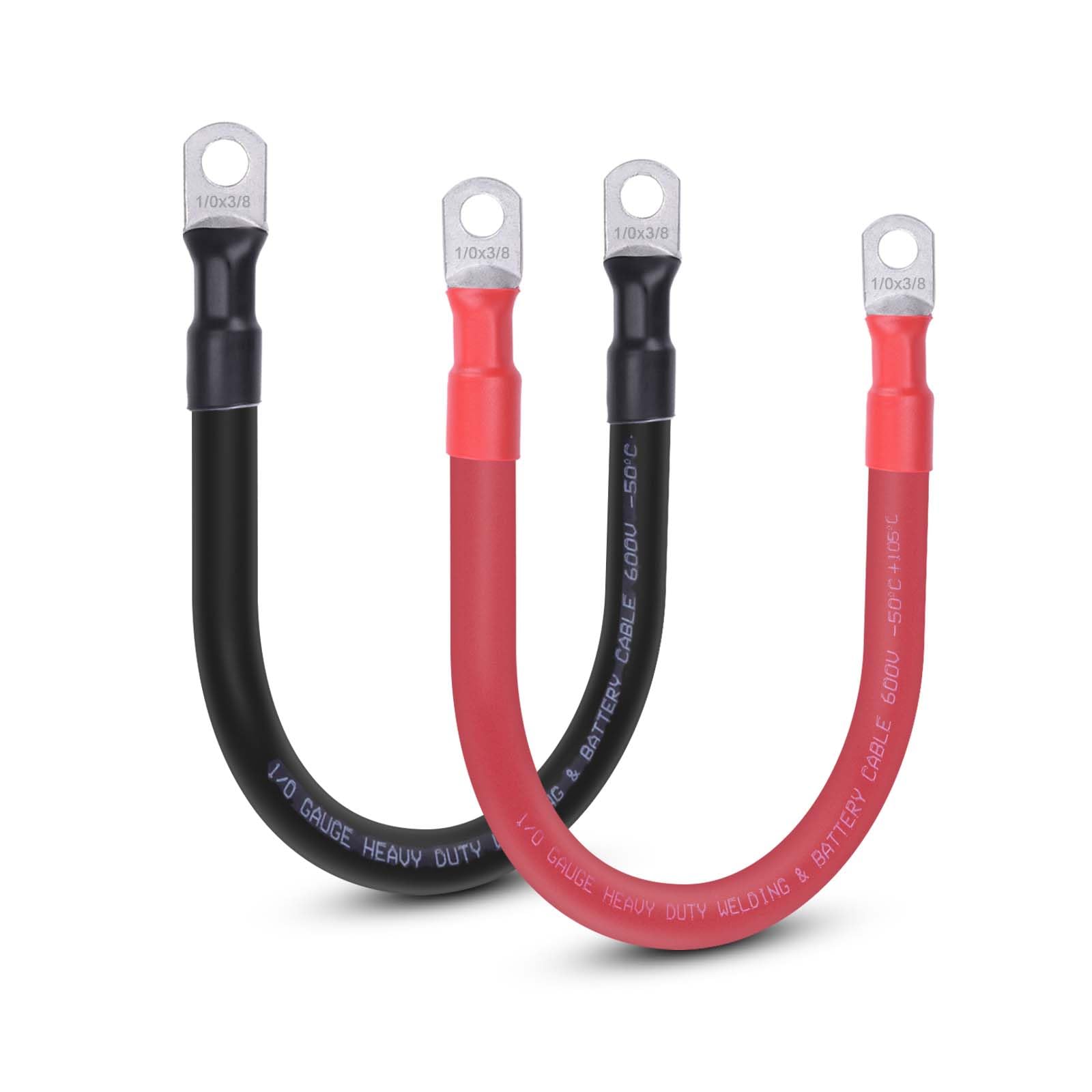
The 1/0 AWG monster that fixed a major ground issue in a Camaro with one bolt-on.
This is the cable you reach for when nothing less than massive current capacity will do. The Shirbly 1/0 AWG pair uses 1,703 strands of 0.2mm annealed pure copper and EPDM rubber insulation, rated for 600 volts and temperatures from -58°F to 221°F. The 3/8-inch ring terminals are pre-crimped and covered with 3:1 dual-wall adhesive heat shrink, which seals out moisture and vibration better than standard tubing. One owner reported that this cable “fixed a major negative ground issue on my Camaro” — proof of the difference a genuinely thick ground path makes.
The EPDM jacket is solvent-resistant and fire-resistant, making it a strong choice for marine engine compartments or solar inverter banks where exposure to fuel vapors is a concern. At 1 foot per cable, these are short dedicated links meant to bridge a battery to a nearby distribution block or starter solenoid. The thickness is the star here — several owners note the wire is very thick, which is exactly what you want for a high-amp application, but it means the cable is not ideal for tight bends around sharp corners.
Uncompromising on capacity
- 1/0 AWG OFC copper handles 300A+ surges without voltage drop
- EPDM insulation resists solvents, fire, and extreme temperatures
- 3:1 adhesive heat shrink seals the connection permanently
- Surprisingly flexible for its massive gauge, per owner feedback
Short and thick
- 1-foot length is only suitable for very close battery-to-bus-bar connections
- Thick wire may not fit some smaller terminal boots
This one is for: anyone wiring a high-power inverter, diesel starter, or auxiliary battery bank that demands maximum ampacity from a short link.
Not for you if: you need a long run to a remote battery — look at the 6 AWG or 2 AWG spool options below.
6. ECO-WORTHY 2 AWG Battery Cable

The tinned-copper 2 AWG cable made for linking batteries in parallel on boats and golf carts.
ECO-WORTHY brings a 2 AWG pair with 5/16-inch nickel-plated ring terminals, which is a common size for battery post clamps on marine and golf-cart batteries. The conductors are tinned copper, giving them a significant edge over bare copper in wet or salty environments — the tin plating resists oxidation that would otherwise creep under the insulation. Each 12-inch cable is rated for a maximum operating current of 150 amps and tolerates temperatures from -76°F to 392°F.
Owners highlight the “thick durable plastic insulation” and the fact that the cables are “ready to be put under a heavy load.” They are a frequent pick for wiring two 6V golf cart batteries in series or connecting a house battery bank in parallel. The nickel-plated lugs are a small but important detail — they resist corrosion at the bolt interface better than plain copper lugs do. The only catch is the 5/16-inch (M8) lug size: if your battery posts use a larger 3/8-inch stud, you will need a step-up adapter or a different cable.
Built for wet environments
- Tinned copper resists corrosion far better than bare copper
- Nickel-plated 5/16-inch lugs stay clean at the connection point
- 150A capacity covers most series/parallel battery bank builds
- Temperature range handles engine bay and outdoor box conditions
Lug size mismatch
- 5/16-inch ring does not fit standard 3/8-inch battery studs without an adapter
Reach for these when: you are wiring golf cart batteries in series or adding a tinned-copper link in a marine battery box.
Choose a different pair if: your battery terminals require 3/8-inch lugs — the A ABIGAIL or TOPDC sets are a direct fit.
7. NOVINO 10/2 Marine Grade Wire
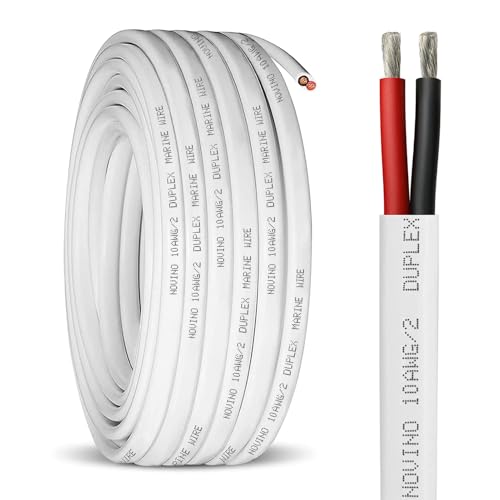
The 30-foot duplex spool that makes rewiring a boat or trailer a single-purchase job.
This NOVINO marine wire is a duplex cable — two conductors (red and black) inside a single white PVC jacket — giving you a clean, waterproof run for 12V circuits on a boat, utility trailer, or camper. Each conductor is true 10 AWG tinned copper with multi-strand construction, rated to UL 1426, SAE, and ABYC standards. That means it is built to resist corrosion, open flame, heat shock, and deformation when installed in a marine environment.
Owners love its flexibility and resistance, calling it “perfect for nautical or outdoor installations.” It is used for everything from navigation lights and bilge pumps to solar inverter leads and trailer brake wires. The insulation is rated to 600V and handles 105°C dry and 75°C wet. Because it is a continuous spool, you cut exactly the length you need — no fighting with pre-terminated cables that are always slightly too short or too long.
Built for harsh saltwater duty
- Tinned copper conductors resist galvanic corrosion in boats
- Meets UL 1426 and ABYC marine standards for fire and heat
- 30-foot length covers most wakeboard tower or trailer runs
- Duplex jacket keeps the run tidy inside a conduit or wire chase
DIY termination required
- No ring terminals or connectors included — you crimp your own
Best for: complete rewiring of a boat, trailer, or camper where you want one spool to handle all 12V accessory circuits.
Not the pick if: you just need a single battery-to-inverter cable — a pre-terminated set is faster.
8. Shirbly 6 AWG Welding Cable

The 6 AWG OFC welding cable that feels more like 4 AWG under the insulation.
Shirbly’s 6 AWG cable uses 423 strands of 0.2mm annealed pure copper wrapped in a thick EPDM rubber jacket. Buyers consistently note that the insulation is “double thickness with a rubbery feel” and that the “copper is larger than typical #6.” That extra copper mass provides a safety margin for thermal performance, making it a favorite for car audio amplifiers, DC-DC charger installations, and solar array combiner boxes.
The EPDM jacket is oil-resistant and fire-resistant, and the cable is rated for 600V with a temperature range of -58°F to 221°F. It is soft enough to bend into tight spaces without kinking — though the thicker-than-normal jacket does make it a little harder to crimp into a standard 6 AWG lug. An occasional owner mentions an unpleasant odor from the jacket when new; airing it out for a day typically resolves it.
Oversized conductor for confidence
- OFC copper is physically larger than typical 6 AWG — runs cooler
- EPDM rubber jacket resists oil, heat, and abrasion
- Very flexible for a 6 AWG — easy to route in tight engine bays
- Ideal for 70A DC-DC chargers and car audio amplifiers
Minor gripes
- Thicker insulation makes crimping harder than standard 6 AWG
- New rubber jacket has a temporary odor for the first few days
Best for: anyone running 6 AWG in a high-vibration or engine-bay environment who wants extra thermal margin without jumping to 4 AWG.
Pick a standard 6 AWG if: you are crimping into pre-insulated connectors that only accept standard jacket diameters.
9. Shirbly 2 AWG Welding Cable

The 2 AWG OFC spool that powers a 3,000W inverter without breaking a sweat.
When your inverter pulls 100 amps continuously or you are wiring a diesel truck’s dual-battery system, 2 AWG is the gauge that delivers. This Shirbly cable is made from 1,070 strands of 0.2mm OFC copper — the same 60-strand-over-20-strand construction as welding cable — wrapped in EPDM rubber that handles 600V and temperatures from -58°F up to 221°F. Owners mention it “handles 100 amp loads without issues” and call the insulation “thick and rubbery,” giving a rich color that feels premium on the workbench.
The cable is surprisingly flexible for its size. While the 2 AWG thickness does mean it takes up more space in a wire loom, the fine stranding lets it follow the contour of a chassis rail without kinking. The printed markings on the jacket start around the 90-foot mark; they do not start at 1 foot, so if you need precise cut-length measurements you will want to lay it out and mark it yourself.
High current, cool operation
- 1,070 strands of OFC copper for maximum conductivity and flexibility
- EPDM jacket resists solvents, oil, and open flame
- 100A+ continuous capacity fits large inverters and dual-battery setups
- Thick rubber insulation feels premium and durable
Two practical notes
- Printed length markings start at ~90 ft, not at 1 ft — measure cuts
- Thick wire requires a large terminal lug (not included)
This is the one if: you are wiring a 3,000W inverter, a dual-battery box in an overland vehicle, or any system that pulls over 80 amps on a 10-foot run.
Use a smaller gauge if: your max load is under 60 amps — 6 AWG or 4 AWG saves weight and cost.
Understanding the Specs
AWG Gauge
AWG stands for American Wire Gauge. A lower number means a thicker wire — 4 AWG is significantly thicker than 10 AWG. Thicker wire carries more current over distance without voltage drop. For a short battery jumper, 4 AWG covers most car and RV needs. For a long run to a solar controller or inverter, you may need 2 AWG or even 1/0 AWG to keep power losses low.
Conductor Material: OFC vs Tinned Copper
Oxygen-Free Copper (OFC) is the purest form for wiring, delivering the lowest electrical resistance. Tinned copper takes OFC and adds a thin tin plating that resists corrosion — essential for boats, marine engine bays, and any outdoors installation where moisture is a constant. Both are far better than copper-clad aluminum (CCA), which has higher resistance and is more prone to breaking.
FAQ
What gauge wire do I need for my car battery?
Can I use welding cable for a battery?
What is the difference between pure copper and tinned copper battery cables?
How do I choose the right terminal size for a battery cable?
How long should my battery cable be?
Can I connect wires of different gauges together?
What does UL Listed mean in a battery cable?
Is silicone wire better than PVC wire for battery connections?
How do I prevent corrosion on battery cable terminals?
Can I run a positive and negative battery cable together in the same conduit?
Final Thoughts: The Verdict
For most people, the wires for battery winner is the A ABIGAIL 4 AWG Battery Cable because it delivers verified pure copper with pre-crimped 3/8-inch terminals at a price that undercuts most competitors. If you need a longer 24-inch reach for a remote inverter, grab the TOPDC 4 AWG Cable Pair. And for high-amp systems like a large inverter or dual-battery box, the Shirbly 2 AWG Welding Cable is the one to reach for.
How We Picked
We do not accept paid placement. Every pick is matched to a real buyer and a real use-case; we do not hands-on test units.
Sources & Methodology
Specifications: manufacturer listings and product documentation. Review insights: verified customer reviews, as of July 2026. Pricing: not shown on this page (it changes often); check the current price via the retailer link.
As an Amazon Associate, GoCarLife earns from qualifying purchases. This does not affect which products we feature.