
Our readers keep the lights on and the garage heater humming. As an Amazon Associate, I earn from qualifying purchases.
Specs are compiled from manufacturer listings and verified buyer reviews and can change over time — please confirm the key details on the product page before buying.
Spending your weekend with a jack and a wire brush only to have the paint flake off in a month is the kind of frustration that turns a satisfying upgrade into a permanent annoyance. This guide cuts through the brand noise to find you the yellow caliper paint that actually sticks, survives road salt, and keeps that pop of color looking fresh for years rather than weeks. You want a finish that screams custom without screaming “I messed up,” and the right paint is half the battle.
I’m Mo Maruf — the founder and writer behind GoCarLife. This guide is built by comparing the manufacturers’ published specifications and the patterns across verified customer reviews, so you get each pick’s real strengths and trade-offs instead of marketing spin.
Whether you are painting a daily driver, a weekend toy, or the project car in the garage, the right yellow caliper paint means the difference between a gloss you’ll show off and a chalky disappointment you’ll want to redo.
Our Picks at a Glance


How To Choose The Best Yellow Caliper Paint
You want a durable, glossy yellow that resists brake dust and road grit. Here are the three specs that tell you which can will actually deliver.
Paint Type: Brush-On Epoxy vs. Spray Can
Brush-on epoxy paints create a harder, thicker film that resists chipping and flaking because they cure through a chemical reaction rather than just solvent evaporation. Sprays are faster and give a smoother initial finish, but they tend to chip at edges where the coat is thinnest. For a daily driver that sees road debris, epoxy is usually the longer-lasting choice. For a show car that sees gentle miles, a quality spray is faster and easier to apply.
Heat Resistance
Your brakes can reach several hundred degrees under hard braking. A paint rated to at least 500°F is the minimum for street use, but paints rated to 900°F or higher offer a wider safety margin for aggressive driving or track days. The number stamped on the can is the temperature at which the binder starts to degrade, not the point at which the color instantly fails — but a higher rating never hurts.
Coverage and Kit Contents
An 8-ounce can of brush-on paint typically covers four standard calipers with two coats. A kit that includes a cleaner, a metal prep solution, and applicators simplifies the job enormously because skipping any of those steps is the number one reason the paint fails. If the product is just the paint, you’ll need to buy the prep items separately. A complete kit costs more upfront but usually produces a better, longer-lasting result.
Quick Comparison
| Model | Best For | Paint Type | Heat Rating | Volume | Amazon |
|---|---|---|---|---|---|
| POR-15 Caliper Paint★ Best Overall | Best Overall Durability | Brush-On Liquid | High-Temp | 8 fl oz | Amazon |
| Dupli-Color AerosolBest Spray Can | Easiest Spray Application | Aerosol | 500°F | 11 fl oz | Amazon |
| 4R Quattroerre.it | Neon Yellow Pop | Brush-On Liquid | High-Temp | 100 ml | Amazon |
| POR-15 Painting Kit | All-In-One Prep + Paint | Brush-On Liquid | 350°F | 4 fl oz | Amazon |
| OMAC Epoxy System | Extreme Heat Resistance | 2K Epoxy | 900°F | 4 fl oz + 1 fl oz hardener | Amazon |
| ERA Paints 2K Spray | Premium Spray Convenience | 2K Aerosol | 500°F | 12 fl oz | Amazon |
| G2 Epoxy System | Pro-Grade Epoxy Finish | 2K Epoxy | 980°F | 500 ml | Amazon |
In‑Depth Reviews
1. POR-15 High Temperature Brake Caliper Paint (8 oz)
Our pick — over 4.5★ from 4,500+ verified ratings; the strongest balance of quality and price.
The brush-on paint that earned its reputation one heat cycle at a time — buyers report years of flawless wear.
This is the pick that nearly five thousand owners have improve to the top of the category. The 8-ounce can of POR-15 brush-on paint is a ceramic-like liquid that self-levels into a gloss finish owners compare to a powder coat. Owners mention one confident coating lasting 5.5 years with no degradation, surviving caustic wheel cleaners that would strip lesser paints. The paint covers all four standard calipers with two coats and still leaves enough for a second car.
The process calls for the POR-15 3-step system — cleaner degreaser, metal prep, and rust preventive coating — before you even open the can. Skip these steps and you risk adhesion issues that have nothing to do with the paint itself. The finish dries in 3-4 hours between coats and needs a full 24 hours before you remount the wheels. Owners who follow the instructions describe a factory-new appearance that makes calipers look like they were dipped, not brushed. The only recurring note: use a quality artist’s brush, not the foam or chip brushes found in hardware stores, to avoid streaks.
The color code here is #FFF301, a true bright yellow that leans slightly warm — owners call it the right shade for a Ferrari-style pop without crossing into orange.
The Five-Year Finish
- Proven real-world durability that stretches past half a decade.
- Self-leveling formula that hides brush marks, giving a spray-like gloss.
- One 8-ounce can paints four calipers with leftover for another car.
The Prep Commitment
- Requires a three-step cleaning/etching system before painting — no shortcuts.
- Full 24-hour cure time before you can drive the car again.
- Color can appear slightly different depending on the primer used underneath.
Reach for this when: you want a set-and-forget finish that you won’t need to touch up for years, and you’re willing to follow the prep routine to get it.
Think twice if: you need a same-day turnaround — the 24-hour cure is non-negotiable for a hard finish.
2. Dupli-Color Caliper Aerosol Paint (11 oz)
The spray that makes a perfect yellow caliper in under an hour, with no brush marks and no mess.
Dupli-Color’s aerosol uses ceramic resins to hit a 500°F heat resistance rating, which is enough for daily street driving and even the occasional autocross session. The 11-ounce can covers 12 to 14 square feet, meaning you will have plenty of paint for all four calipers and the rotors if you want a coordinated look. The EZ Touch conical nozzle delivers a controlled fan that owners describe as running smoothly and evenly. One owner applied three coats of primer, five coats of paint, and three coats of clear for a deep build, but the manufacturer says it is dry to the touch in 30 minutes and ready to handle in 1 hour — dramatically faster than any brush-on system.
The real-world report that stands out is a 2006 Altima that held its yellow for 16 months in daily service, with the paint surviving road debris impacts and mechanic handling with only minor chips. The biggest gotcha: if you overspray onto the brake pads or rotors, you can introduce a squeak, so careful masking is mandatory. A few owners note that the paint is forgiving and self-heals if you lay it on a little heavy and catch it before it runs.
Unlike the POR-15, this product is not waterproof on its own, so a clear topcoat is a smart addition if you drive in wet or salty conditions. That said, for a spray can, the quality and color depth here are tough to beat.
The Speed Advantage
- Ready to handle in one hour — the fastest route to a finished caliper.
- Smooth fan spray pattern with a forgiving, self-healing layer.
- 11-ounce can provides generous coverage for all four corners.
The Overspray Risk
- Overspray on rotors or pads can create brake squeak that requires disassembly to fix.
- Not explicitly waterproof; road salt and moisture exposure may shorten the finish.
- Some customers note it needs more coats than expected for full opacity.
Grab this if: you want a fast, easy spray application and you are ready to tape everything off carefully.
Look elsewhere if: you drive in heavy winter salt or want a no-compromise waterproof layer without adding a clear coat.
3. G2 High Temperature Brake Caliper Paint System G2161
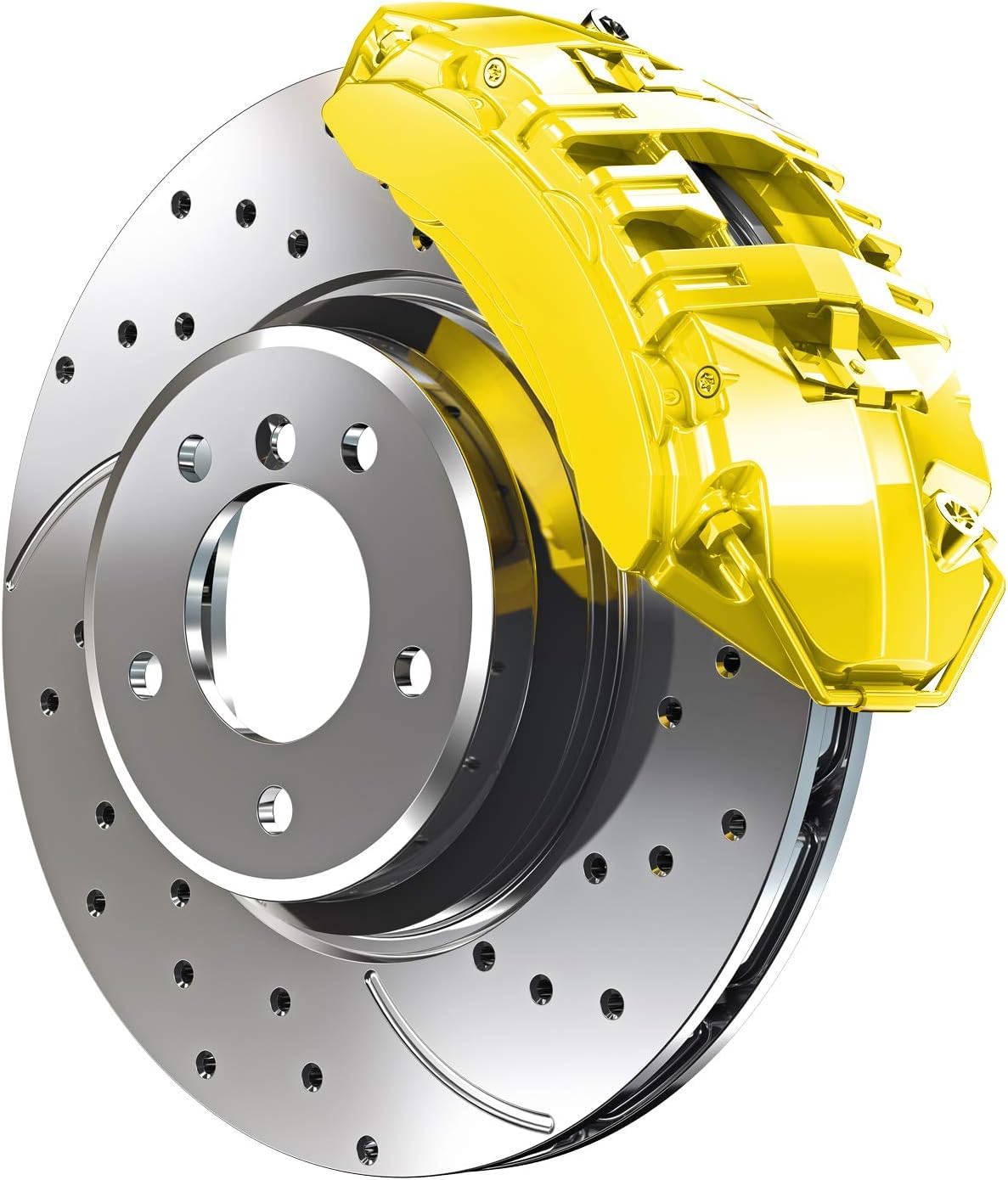
The two-part epoxy system that is the standard for enthusiasts who want a true powder-coat look at home.
G2’s kit is the most-reviewed caliper paint on Amazon, and for good reason. The two-component epoxy formula (paint plus a glass bottle of high-temperature epoxy reactor) creates a chemical cross-link that resists heat up to 980°F and comfortably into track-day territory. The kit includes everything: an aerosol brake cleaner, the epoxy paint, the reactor, a stirrer, a brush, and a color decal. Each complete kit reliably paints four disc brake calipers or two drums.
What owners praise most is the finish quality. The epoxy dries to a super-glossy, hard shell that collects compliments. It is tack-free in about 30 minutes and solid by the next day, though full heat-curing happens over subsequent drives. The color is a deep, high-visibility yellow that satisfies owners looking for a bold statement. A critical safety note that comes up repeatedly: you must remove or mask the rubber piston dust boots and seals before painting, because the epoxy debris can create a mechanical hazard if it gets inside the piston bore. Owners who take calipers off the car and use a 1/2-inch angled brush get the best results.
On the downside, durability is a mixed topic. Most reviewers point out years of great wear, but a minority note that a direct impact during reassembly can chip the finish — this is an epoxy truth, not a G2 problem. The kit also comes with serviceable brushes, but experienced owners recommend upgrading them for better precision.
The track-grade formula: 980°F heat resistance and epoxy hardness that beat 90% of the competition.
The prep depth: The full process — dismount, mask boots, clean, etch, react, paint, cure — takes a full weekend if done properly.
Choose this for: a true professional-grade result on a car that sees hard braking, track time, or all four seasons.
skip it if: you want a quick in-place spray job — this kit demands disassembly and careful masking for safe results.
4. POR-15 Caliper Painting Kit (4 oz)

Everything you need to go from rusty caliper to glossy yellow in one box — no guesswork, no separate trips to the store.
This kit bundles the cleaner degreaser, metal prep, and caliper paint into one purchase, solving the biggest frustration of the POR-15 system: hunting down the three-step chemistry separately. The paint is the same ceramic-like gloss formula as the standalone 8-ounce can, but here you get a 4-ounce bottle that the manufacturer says is enough for four calipers. The heat rating is listed at 350°F, which is lower than the standalone can — this kit is aimed at street use rather than track work.
The customer feedback splits cleanly. Owners who follow every step of the written and video instructions report a smooth, impressive finish that transforms the look of their car. A 59-year-old first-timer describes painting her own calipers and loving the result. The counterpoint: a few owners had adhesion trouble, and the common thread is almost always skipping the metal prep step. The paint dries to a beautiful gloss, but thin first coats are the norm — you need three coats for full, even coverage. The upside is that the kit has enough paint for roughly six coats, leaving you material for touch-ups months later.
The downside to this convenience is the price — the kit costs nearly double the standalone paint — but if you do not already own degreaser and metal prep, it saves the headache of sourcing them.
The true one-stop system: Degreaser, metal etch, and paint in one box with a clear video walkthrough.
The 350°F ceiling: Fine for street and highway use, but soft for repeated track sessions or aggressive canyon driving.
Best for: someone doing their first caliper job who wants every tool and chemical handed to them with clear instructions.
Not for: experienced owners who already own cleaning and etching supplies — you are paying for duplication.
5. OMAC High Temperature Brake Caliper Paint System Kit
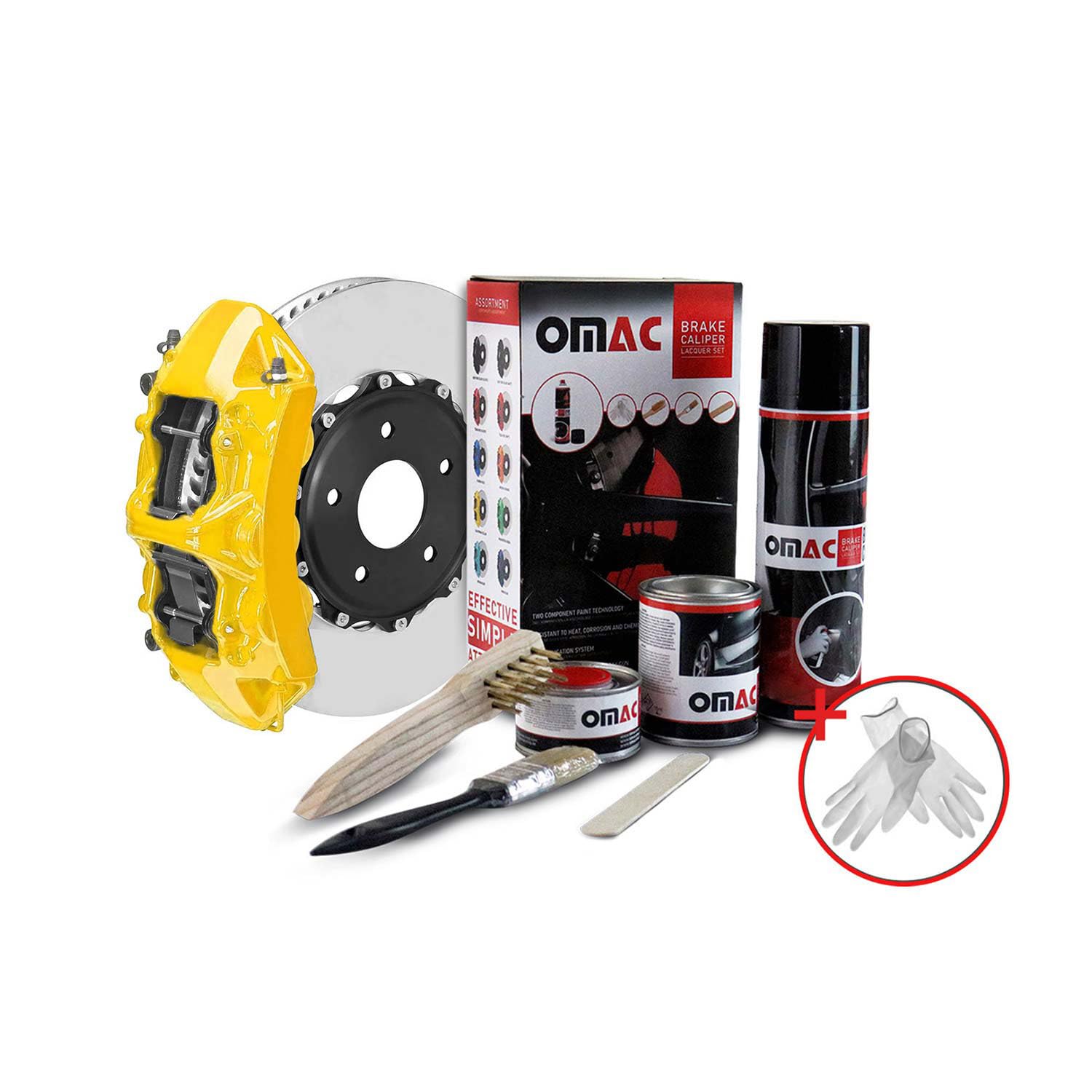
The two-component epoxy kit that promises 900°F resilience and delivers a glossy, chip-resistant finish.
OMAC’s system uses a two-component epoxy base that kicks off a chemical reaction when you mix the paint with the included hardener. The result is a film that OMAC rates to 900°F, putting it in the same league as the G2 in raw heat tolerance. The kit is generous: a 17-ounce brake cleaner, 4 ounces of lacquer, 1 ounce of hardener, a steel brush, a painting brush, gloves, and a spatula. The brush-on approach is meant to produce a thicker, harder layer than any spray can, and the owner feedback on the final look is very positive — the appearance and glossy finish are the most-praised aspects.
The real-world reports get interesting here. Several owners rave about the vibrant yellow and quick drying time. One applied three coats 20-30 minutes apart and had the wheels back on in two hours, reporting no chipping or peeling three weeks in. Others, however, found the coverage thin and messy. One detailed experience mentions running out of paint on the last caliper after two coats, ending up with a “globby” finish that needed to be sanded and resprayed. The quantity is clearly borderline for four calipers, so work thin and efficient.
The biggest warning from owners: the paint stays tacky for a full day and needs a heat cycle (driving the car and getting the brakes warm) to fully harden. If you reassemble too soon, you risk the paint lifting. OMAC does not make this cure time obvious in the instructions.
The epoxy edge: 900°F rating and a chemical-hardening film that spray paints cannot match for edge toughness.
The coverage gamble: Several shoppers say the 4-ounce + hardener mix runs short on the last caliper; two coats max per caliper.
Ideal for: owners who prioritize heat resistance and a glossy finish and are comfortable with the unpredictable coverage.
Pass if: you want a predictable, no-fuss painting experience with known per-caliper quantity.
6. ERA Paints 2K Brake Caliper Spray Paint (12 oz)

A spray can with a twist: a built-in hardener button that turns it into a true 2K coating from an aerosol.
ERA Paints takes a different path than the standard spray can. The cap hides a red button that releases a separate hardener into the paint, activating a chemical cure that the company says delivers a chip- and fade-resistant finish. At 500°F, the heat resistance is on par with the Dupli-Color, but the 2K chemistry means the final film is harder than a standard one-part aerosol. The 12-ounce can is the largest spray volume in this lineup, and it is waterproof — unlike the Dupli-Color — which is a real advantage for winter driving.
Owners who use the activator button correctly report a fine, even fan pattern and a dry-to-touch time under one hour, with an 8-hour full cure. One owner who was skeptical after reading negative reviews ended up very pleased, noting that the spray pattern is forgiving. The available reviews are still a small sample (roughly three dozen), so the long-term picture is less established than the POR-15 or G2 products. But for a spray can that cures harder than standard aerosols, this is the most interesting new option.
The trade-off is that once you push the red button and activate the hardener, you have about 24 hours to use the entire can before the paint solidifies inside the can. You cannot save half a can for a future project.
The 2K spray breakthrough: Aerosol convenience with a chemically activated hardener for better chip resistance than single-part sprays.
The one-shot can: Activate the hardener and use the whole can in a day — no storing leftovers for later touch-ups.
Reach for this when you want a waterproof, hard-curing spray finish and are comfortable using the whole can in one session.
Look elsewhere if you want a multi-project can or a long-established track record with thousands of reviews.
7. 4R Quattroerre.it High Temperature Paint (100 ml)

The fluorescent yellow that demands a white base coat — and that turns out to be both its trick and its trip-up.
The 4R Quattroerre paint is based on silicone resins for high-temperature grip, and it packs a fluorescent yellow that is brighter than anything else in this list. The 100 ml (roughly 3.4 fluid ounces) is the smallest container here, and the kit includes a brush and a cleaner. The manufacturer is explicit: you must start with a white base coat or use a white high-temperature paint underneath, because the fluorescent pigment is semi-transparent on its own. This is not a minor recommendation — it is the difference between a vibrant neon and a disappointing yellow tint.
The owner reviews are a mixed bag that mainly trace back to that transparency issue. A few owners in the original Italian were very happy with the coverage and durability. But several others report that the paint did not cover at all, describing it as almost a transparent layer that ruined the look of their calipers. One owner on a Subaru Impreza followed the instructions and was left with a poor result. The paint itself is high-temperature resistant and the chemistry is sound, but the cultural and language barrier in the instructions may contribute to the mixed results. This is a niche product for a buyer who knows exactly what they are doing with fluorescent pigments.
If you love the idea of a true neon yellow caliper and you own a white spray paint for the base layer, this can work. If you want a straightforward single-coat yellow, this is not the one.
The brightest shade: Genuine fluorescent yellow that no other paint in this lineup matches for sheer visibility.
The white base trap: The paint needs a white undercoat to show its true color; without it, the coverage is nearly transparent.
Try this for: a show-caliber fluorescent look if you are ready to apply a separate white base coat first.
Avoid if: you want a one-and-done paint that covers the caliper in two coats — this needs a system, not a single can.
Understanding the Specs
Heat Resistance Rating
This number (500°F, 900°F, etc.) is the temperature at which the paint’s binder starts to break down chemically. For daily street driving, your brake rotors can hit 300-400°F, so a 500°F rating gives a safe margin. For track days, heavy towing, or mountain descents, you want 900°F or higher. A higher rating also usually means a more heat-stable pigment, so the yellow stays yellow longer instead of baking brown.
2K / Two-Component vs. Single-Stage
“2K” means the paint comes in two parts — a base and a hardener — that you mix just before use. The chemical reaction creates a film that is significantly harder and more solvent-resistant than single-stage paint. The trade-off is limited pot life: once mixed, you have a few hours to use it all. Single-stage paints (sprays or brush-on) dry by solvent evaporation alone and are easier to store leftover, but the film is softer and more prone to chipping at sharp edges.
FAQ
Can I paint the calipers without removing them from the car?
How long does yellow caliper paint last before fading?
What is the most common mistake owners make during application?
Can I use a clear coat over yellow caliper paint?
How does brush-on paint compare to spray paint for a beginner?
Will yellow caliper paint withstand a pressure washer?
Do I need a primer for yellow caliper paint?
Is there a difference in heat rating between brush-on and spray paints?
How many coats of yellow paint do I need for full coverage?
Can I mix different brands of caliper paint and hardener?
Final Thoughts: The Verdict
If you want one dependable pick, the best yellow caliper paint winner is the POR-15 Caliper Paint because it combines proven 5.5-year durability with a self-leveling gloss that looks like a powder coat. If you want the fastest spray application and do not mind careful masking, grab the Dupli-Color Aerosol. And for a pro-grade epoxy finish that handles 980°F heat, the G2 Epoxy System is the one to reach for. The crowd favorite — 4.6 stars across thousands of owners — confirms POR-15 as the kit to beat.
How We Picked
We do not accept paid placement. Every pick is matched to a real buyer and a real use-case; we do not hands-on test units.
Sources & Methodology
Specifications: manufacturer listings and product documentation. Review insights: verified customer reviews, as of July 2026. Pricing: not shown on this page (it changes often); check the current price via the retailer link.
As an Amazon Associate, GoCarLife earns from qualifying purchases. This does not affect which products we feature.