
Our readers keep the lights on and the garage heater humming. As an Amazon Associate, I earn from qualifying purchases.
Specs are compiled from manufacturer listings and verified buyer reviews and can change over time — please confirm the key details on the product page before buying.
Yellow coolant is the quiet workhorse of modern engines, but picking the wrong one means you are flushing money down the drain or, worse, cooking your block. Between concentrate versus premix, universal versus manufacturer-specific, and the bewildering spectrum of colors, the real question depends on one thing: which yellow fluid actually delivers the corrosion protection and temperature range your vehicle demands, without a leak or a gasket failure down the road.
I’m Mo Maruf — the founder and writer behind GoCarLife. This guide is built by comparing the manufacturers’ published specifications and the patterns across verified customer reviews, so you get each pick’s real strengths and trade-offs instead of marketing spin.
Whether you drive a gas-guzzling truck, a modern sedan, or an RV with a hydronic heating system, the best yellow radiator fluid protects your engine from extreme temperatures and internal corrosion while staying affordable.
Our Picks at a Glance
How To Choose The Best Yellow Radiator Fluid
Yellow coolant is typically an OAT (Organic Acid Technology—a chemistry that uses organic acids instead of silicates for long-life protection) formula, meaning it provides long-life protection without the silicates (sand-like particles) found in older green coolants. But not all yellow fluids are the same — some are concentrated, some are prediluted, and some are built for specific vehicle brands or RV heating systems. Here is what to look for.
Concentrate vs Prediluted (50/50)
A concentrate gives you control over the water-to-coolant ratio. If you mix it at 50/50 with distilled water, you get protection down to -34°F and boiling protection up to 265°F. A 60/40 mix pushes the freeze point down to -62°F. The trade-off is that mixing takes time and a little bit of measurement. A prediluted 50/50 bottle, on the other hand, is ready to pour straight into your reservoir. The convenience is real — you pop the cap and top off. But you are also paying for water, and you cannot tailor the ratio for extreme climates.
Vehicle Compatibility and Color Matching
Modern engines use specific coolant chemistries that match the type of metals in the block and radiator. Using a universal yellow coolant in a vehicle that calls for orange or pink can lead to gelling or corrosion over time. The safest route is to check your owner’s manual for the approved coolant spec (for example, Ford requires Motorcraft VC-13-G for many models). When in doubt, a premium universal yellow formula that meets ASTM D3306 and D6210 (industry performance standards for coolant) is a solid fallback.
Protection Additives and Bittering Agents
Quality yellow coolants contain corrosion inhibitors that protect aluminum, copper, brass, and steel from rust and scaling. They also include a bittering agent like Denatonium Benzoate (the most bitter substance known—added to prevent accidental ingestion) to deter accidental ingestion by pets or children. This is a safety standard you want present in any fluid that stays in a garage or driveway.
Quick Comparison
| Model | Best For | Type | Weight | Protection Range | Amazon |
|---|---|---|---|---|---|
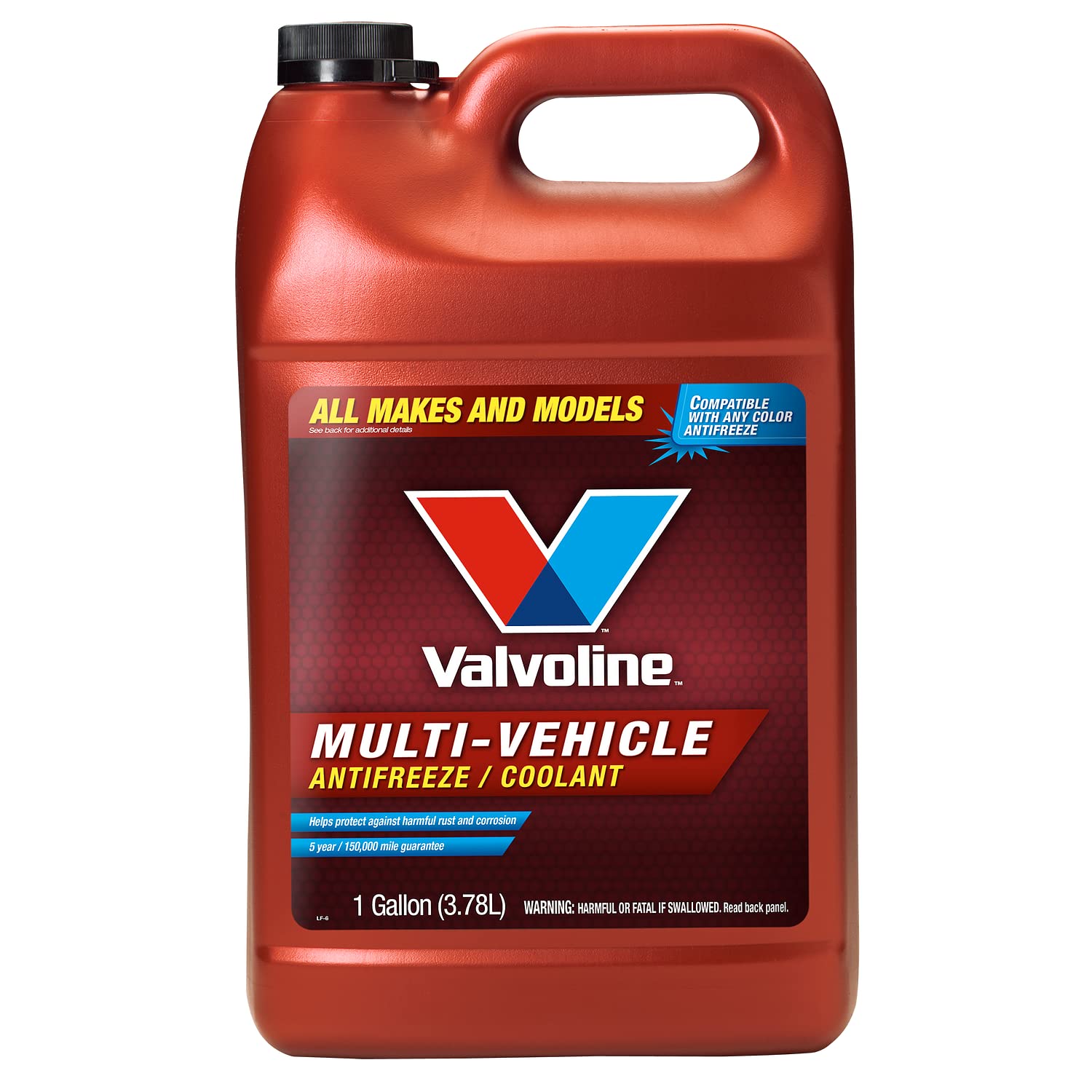
| Valvoline Multi-Vehicle Concentrate★ Best Overall | DIY mix-your-own value | Concentrate | 9 lb | -34°F to 265°F (50/50) | Amazon |
| PEAK Titanium 50/50 Prediluted | Premium lifetime protection | 50/50 Prediluted | 7.59 lb | 500,000+ miles | Amazon |
| Anti-Freeze (Motorcraft VC-13-G) | Ford/Motorcraft specific | Concentrate | 9.66 lb | OEM spec | Amazon |
| RecPro RV Boiler Antifreeze | Aqua-Hot RV systems | Prediluted | — | Freeze + high boil | Amazon |
In‑Depth Reviews
1. Valvoline Multi-Vehicle Concentrate Antifreeze Coolant 1 Gallon
Our pick — over 4.5★ from 450+ verified ratings; the strongest balance of quality and price.
The yellow concentrate that gives you total control over your mix ratio and your budget.
This is the pick for anyone who prefers full-strength concentrate over premix. The Valvoline yellow formula protects all cooling system metals, including aluminum, with Alugard Plus additives that fight corrosion, scaling, and rust. At a 50/50 mix with tap or distilled water, you get freeze protection down to -34°F and boil-over protection up to 265°F. If you live in a colder region, a 60/40 or 70/30 ratio pushes the freeze point even lower, all the way to -84°F. That kind of adjustable range is something a premix can never give you.
The bottle weighs 9.66 pounds — noticeably heavier than the PEAK Titanium premix at 7.59 pounds, but that extra weight is pure concentrate, not water. Owners appreciate the full-strength approach: as one buyer put it, “I like that I can get the antifreeze in full strength and I com mix it myself I don’t like paying for the premixed stuff saying for water.” The universal fit means it works in cars and light-duty trucks regardless of brand. The only real callout is that you need a clean container and some distilled water, so it is not an instant grab-and-pour solution.
Mix-it-yourself value: The highest-rated concentrate in this roundup, and the crowd favorite for good reason — you pay for actual coolant, not water, and you dial in the exact protection level your climate demands.
Reach for this if: you want to mix your own ratios for extreme temperatures and avoid paying a premium for premixed water.
Look elsewhere if: you just want to top off a low reservoir with no measuring or mess.
2. PEAK Titanium 50/50 Prediluted Antifreeze and Coolant for All Engine Cooling Systems

The prediluted formula that guarantees engine protection for over 500,000 miles or 15 years.
PEAK Titanium is engineered to support any vehicle’s cooling system while you do almost nothing — just open the bottle and pour. The 50/50 prediluted formula is already mixed, compatible with all coolant colors and technologies, and designed to clean component surfaces while preventing heat-insulating films that cause overheating. It earned a perfect 10 score in industry-standard water pump protection testing (ASTM D2809—a lab test that measures how well a coolant prevents pump impeller pitting). That kind of test result means your water pump impeller stays intact far longer than with conventional coolants.
Buyers report real results: one owner noted that a diesel engine coolant level drop was fixed and the warning light turned off immediately after topping off. The product weighs 7.59 pounds, lighter than the Valvoline concentrate, because it is half water. The trade-off is that you cannot beef up the concentration for extreme Arctic conditions — it is fixed at 50/50. But for year-round driving in most climates, the 15-year/500,000-mile guarantee is hard to argue with.
What owners rave about
- Perfect 10 in water pump protection testing — your pump lasts longer
- Ready to pour with zero mixing, even works on diesel engines
- 15-year or 500,000-mile guaranteed protection
The one limit
- Fixed 50/50 ratio means you cannot dial in more freeze protection for extreme cold
Grab this for: a set-and-forget coolant that works across multiple vehicles and meets the highest industry durability standards.
skip it if: you live where temps regularly drop below -34°F and need a custom mix.
3. Anti-Freeze (Motorcraft VC-13-G) 1 Gallon
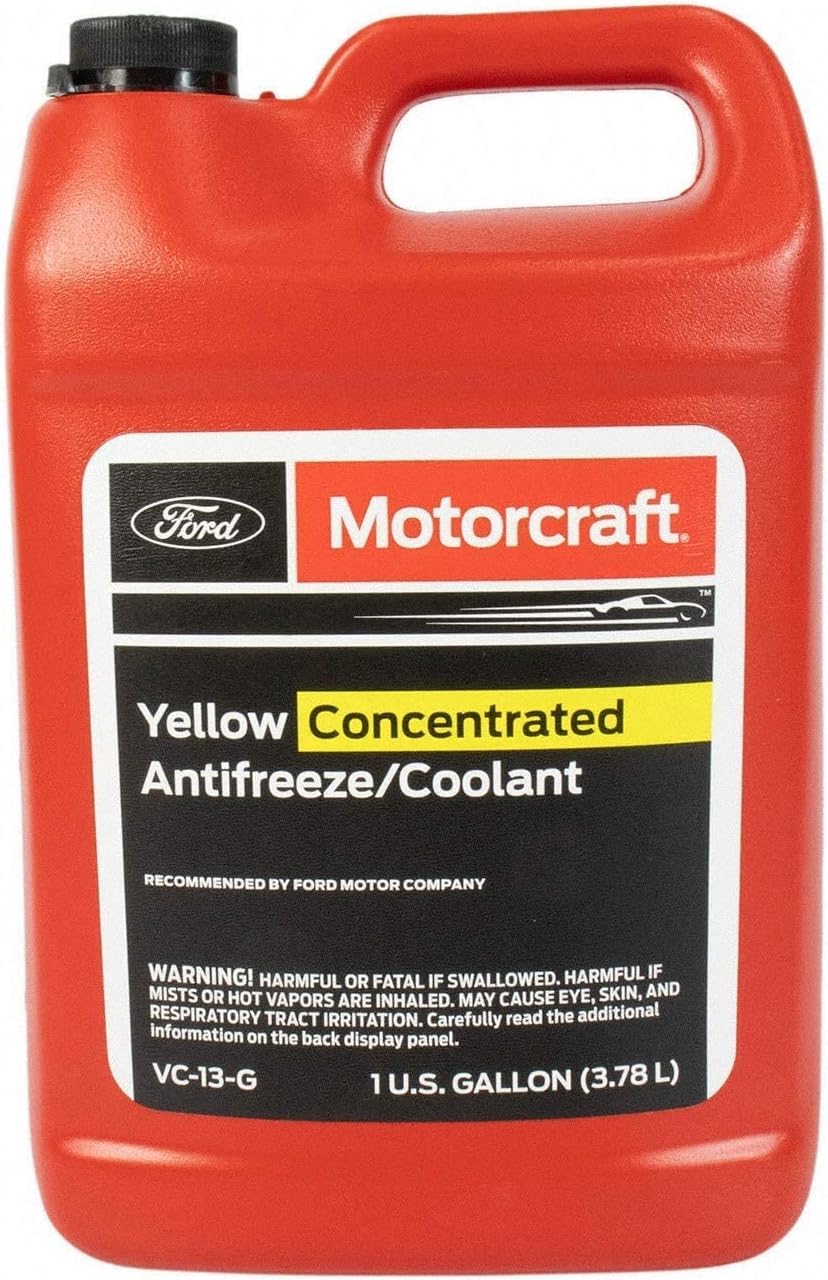
The genuine Ford Motorcraft yellow coolant that owners trust for their F-150s and Super Duties.
If you drive a Ford, this is the specific coolant engineers designed for your cooling system. The part number VC-13-G is the official Motorcraft yellow concentrate formula. It is not a universal catch-all — this is the exact fluid your F-150, F-250, or Expedition expects. The bottle tip: check your manual to confirm if your Ford requires orange or yellow, because getting it wrong can affect gasket and hose life.
The product weighs 9.66 pounds, on par with the Valvoline concentrate, and it is a full-strength formula that you mix yourself. Owners of multiple Ford trucks praise the convenience of buying it on Amazon instead of standing in line at the auto parts store. As one experienced gearhead put it: “I’m an old gear head who grew up buying universal Zerex or whatever antifreeze. Then I learned that cooling systems have advanced and we need to match the factory tuned antifreeze. This is what my Fords take.” The only catch: it is a Motorcraft-specific product, so it does not make financial sense for a mixed-brand garage.
Brand-lock value: Exactly what Ford recommends for its yellow-coolant engines, delivered as a concentrate so you control the mix — but it is not a universal fluid for non-Ford vehicles.
Buy this if: you own one or more Ford vehicles and want the factory-spec fluid without the dealership trip. For a mixed-brand garage, pick the Valvoline concentrate instead — it works across makes and saves you from stocking multiple bottles.
4. RecPro RV Boiler Antifreeze for Aqua-Hot System | 1 Gallon
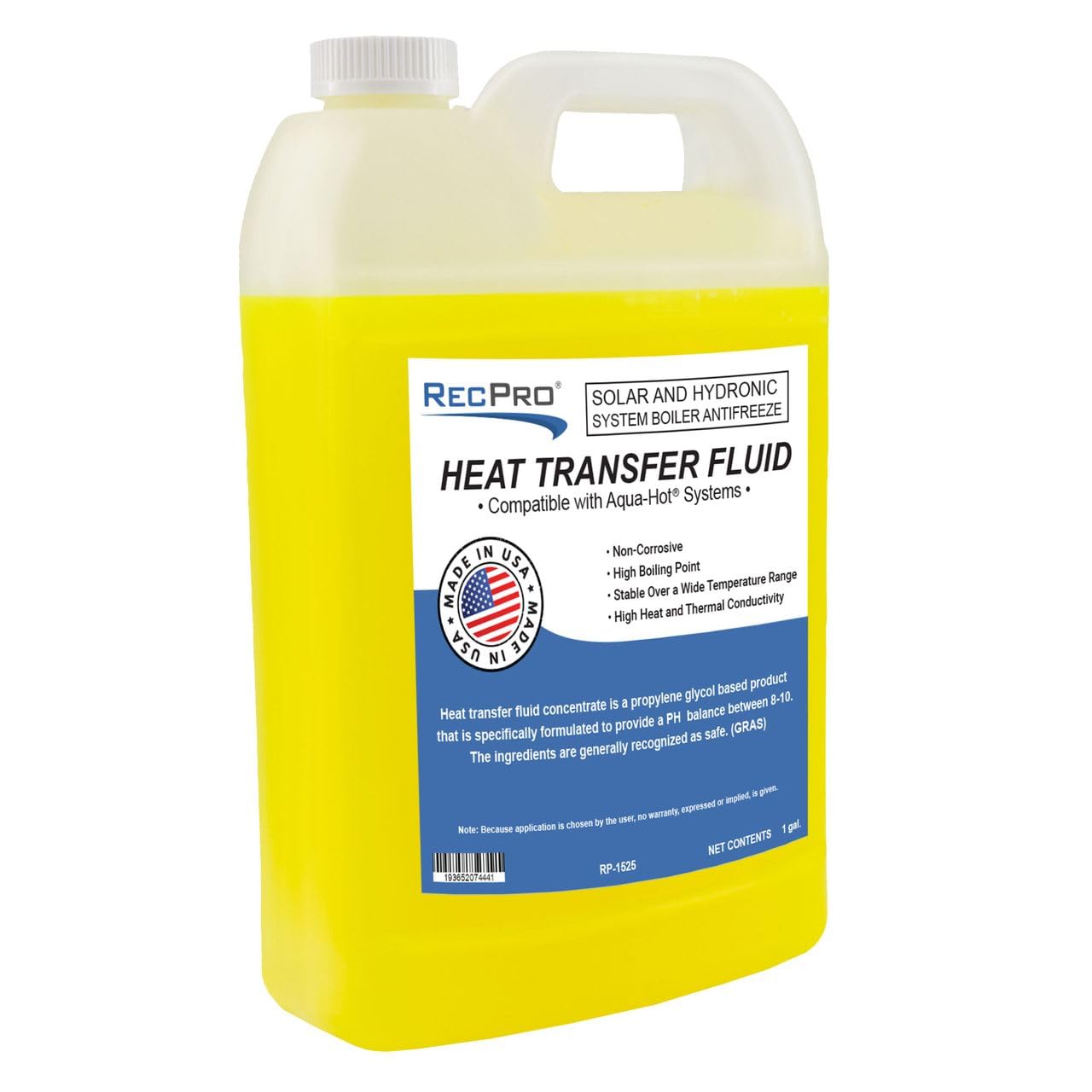
The yellow propylene-glycol fluid your Aqua-Hot RV heating system needs — no dilution required.
This is a very different animal from the coolants above. The RecPro is a propylene-glycol-based boiler antifreeze designed specifically for Aqua-Hot and similar RV hydronic heating systems, not for an engine radiator. It is yellow, non-corrosive, protects against freezing, carries a high boiling point, and needs zero dilution — you pour it straight in. If you own an RV with an Aqua-Hot system, using the wrong fluid can damage the boiler loop, so this is the correct yellow variant for that job.
Owners consistently call out the price as a standout: local brick-and-mortar retailers charge to per gallon for the same type of fluid, making the RecPro a massive savings per gallon, especially when you need seven or eight gallons to fill the system. One reviewer noted needing 7 gallons to fill their system and receiving 8 the next day — getting the job done quickly at roughly half the local price. The catch is straightforward: this is not for your car or truck radiator. It belongs in the boiler bay of an RV coach, not under a hood.
Why RV owners love it
- Non-corrosive formula safe for heating system metals
- Ready to use — no mixing or diluting required
- Significant savings vs local RV parts counters
The one firm limit
- Engineered for RV hydronic systems only — not a substitute for engine coolant
Choose this for: an Aqua-Hot RV boiler that needs propylene-glycol yellow fluid at a fair price.
Do not buy this for: topping off your truck or car radiator — pick one of the engine coolants above instead.
Understanding the Specs
OAT vs HOAT Chemistry
Yellow radiator fluid is almost always an OAT (Organic Acid Technology—a chemistry that uses organic acids to prevent corrosion) formula. It uses organic acids to protect against corrosion without silicates (sand-like particles) found in green coolant. HOAT (Hybrid OAT) blends in some silicates for extra aluminum protection. The yellow bottles above are OAT-based and provide extended life intervals — commonly 5 years or 150,000 miles — compared to the 2-year lifespan of old green IAT coolant. If your vehicle calls for yellow, stick with yellow; mixing OAT with IAT can cause gel formation.
Concentrate vs Prediluted 50/50
A concentrate gives you a pure coolant that you blend with distilled water. A 50/50 prediluted bottle is already at the ideal ratio for most climates, so you pour it directly into the reservoir. Concentrate saves you money per gallon of usable fluid and lets you adjust the ratio for extreme cold. Prediluted saves you the mixing step and eliminates the chance of using the wrong water (tap water can introduce minerals that scale your radiator). Choose based on whether you value control or convenience.
Denatonium Benzoate (Bittering Agent)
Many yellow coolants contain between 30 and 50 ppm of Denatonium Benzoate (the most bitter substance known—added to prevent accidental swallowing) — the most bitter substance known to humans. It is added to discourage children and pets from drinking the sweet-smelling but toxic fluid. A single taste is enough to cause immediate spitting. This is a safety feature you want present in any coolant stored in a home garage or driveway.
ASTM Standards and Water Pump Protection
The ASTM D3306 standard covers the performance requirements for engine coolant. The D6210 standard adds heavy-duty diesel engine requirements. The D2809 test (a lab test that measures coolant’s ability to prevent water-pump impeller damage) specifically measures how well a coolant protects the water pump from cavitation and erosion. A perfect score of 10, which the PEAK Titanium earned, means it provides maximum protection to the pump impeller surface, preventing the pitting that leads to coolant leaks and pump failure.
FAQ
Can I mix yellow coolant with green or orange coolant?
Is yellow radiator fluid the same as universal coolant?
How often should I change yellow radiator fluid?
Can I use yellow concentrate without diluting it?
Will yellow coolant work in my Ford F-150?
Does yellow coolant protect aluminum engines better than green?
Can I use RV boiler antifreeze in my car’s radiator?
What does the bittering agent in yellow coolant do?
Final Thoughts: The Verdict
For most drivers, the yellow radiator fluid winner is the Valvoline Multi-Vehicle Concentrate because it combines a crowd-favorite 4.8-star rating with the flexibility of a true concentrate — you control the mix ratio, skip the water cost, and protect every cooling system metal including aluminum. If you prefer the convenience of a bottle you pour straight in, grab the PEAK Titanium 50/50, which guarantees protection for over 500,000 miles. And for Ford owners who want the exact factory fluid, the Motorcraft VC-13-G is the one to reach for.
How We Picked
We do not accept paid placement. Every pick is matched to a real buyer and a real use-case; we do not hands-on test units.
Sources & Methodology
Specifications: manufacturer listings and product documentation. Review insights: verified customer reviews, as of July 2026. Pricing: not shown on this page (it changes often); check the current price via the retailer link.
As an Amazon Associate, GoCarLife earns from qualifying purchases. This does not affect which products we feature.